The average knowledge worker switches between apps over 1,200 times per day. Almost none of them chose this. It was built into the way work was set up. Here is what it is costing and what the alternative looks like
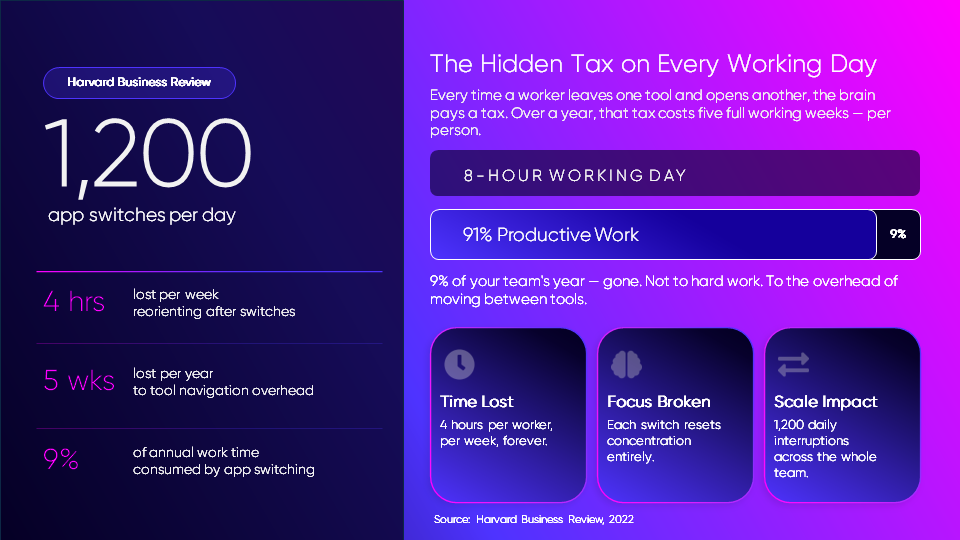
The Harvard Business Review published research in 2022 showing that the average digital worker toggles between applications and websites nearly 1,200 times per day and spends almost four hours per week reorienting themselves after switching apps. Over a full year, that is roughly five working weeks, or about nine percent of annual work time, lost entirely to the overhead of navigating between disconnected tools.
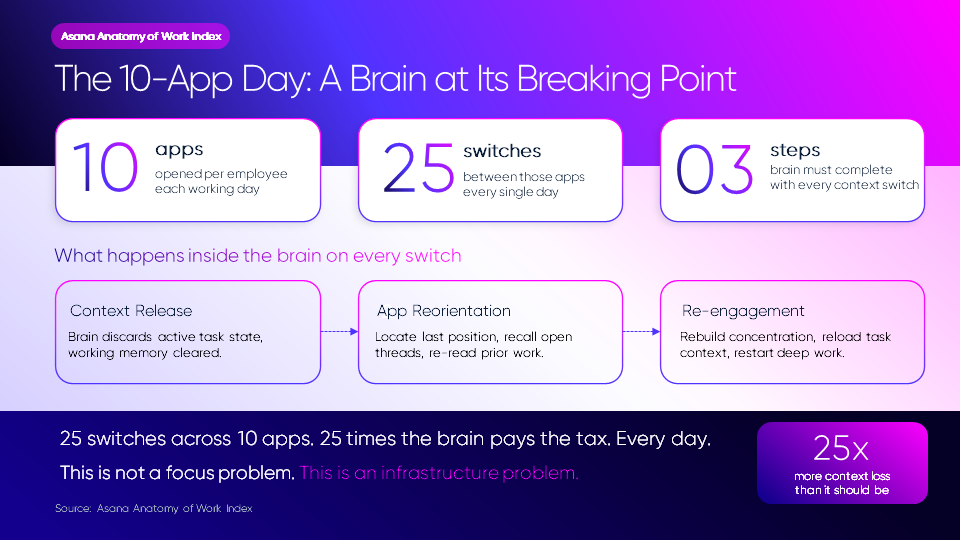
Asana’s Anatomy of Work Index found that employees use approximately ten different applications per day, switching between them around 25 times on average. Each switch forces the brain to reload context, recall where it left off, and re-engage with a different type of cognitive task.
None of this is happening because employees are inefficient. It is happening because the tools they use were designed in isolation, for isolated workflows, by teams that did not anticipate how their product would need to connect with the rest of the enterprise’s software stack.
The Tool Stack That Most Operations Teams Are Running
Here is a composite of what a typical operations or procurement team uses to manage a single vendor engagement from initiation to completion:
| Tool | What It Handles | Where It Breaks Down |
| Communication, approvals, document sharing | No structured workflow. Approvals get lost. No audit trail. | |
| Spreadsheet | Vendor tracking, PO logging, budget monitoring | Manual updates. Version control issues. No live data. |
| E-sign tool | Contract and document signing | Signature is isolated. Nothing triggers automatically after signing. |
| Project management tool | Milestone tracking and task assignment | Vendor-specific context missing. No procurement connection. |
| Finance system | Invoicing and payment processing | Disconnected from delivery status. Invoice disputes require manual reconciliation. |
The result is a workflow that requires five logins, five mental context shifts, and five opportunities for information to fall through the cracks for a single vendor engagement. Multiply that by the number of active vendors and concurrent projects in the organisation and the overhead becomes the dominant feature of the working day.
What the Research Says This Is Costing
The Lokalise Tool Fatigue Productivity Report (2026) surveyed 1,000 knowledge workers and found that 79 percent of employees say their company has taken no steps to reduce tool fatigue or consolidate platforms. Workers switch between tabs, apps, or platforms an average of 33 times per day. More than one in five workers loses at least two hours per week to tool fatigue alone, adding up to over 100 hours of lost productivity per year per employee.
The University of California, Irvine’s foundational research on workplace interruptions established that it takes an average of 23 minutes and 15 seconds to fully regain deep focus after a significant interruption. When workers face interruptions every few minutes through tool switching and notification overload, sustained focused work becomes structurally impossible.
The economic implication is not theoretical. It compounds across every employee, every day, every quarter.
| Metric | Research Finding |
| Daily app switches | Over 1,200 per knowledge worker per day (Harvard Business Review, 2022) |
| Weekly time lost to context switching | Approximately 4 hours per week per worker (Harvard Business Review, 2022) |
| Annual time lost | Equivalent to 5 working weeks, or 9% of annual work time (Harvard Business Review, 2022) |
| Time to regain focus after interruption | 23 minutes and 15 seconds (University of California, Irvine) |
| Workers experiencing no tool consolidation | 79 percent of employees (Lokalise Tool Fatigue Report, 2026) |
| Workers losing 2+ hours weekly to tool fatigue | 22 percent of the workforce (Lokalise, 2026) |
The Consolidation Argument
The case for consolidating business tools into fewer, more connected platforms is not primarily about cost reduction, although that is a real benefit. It is about the quality of work that becomes possible when context does not have to be manually transferred between systems.
When the e-sign event is in the same system as the purchase order, the vendor record, and the project milestone, the signature triggers the downstream workflow automatically. When the approval workflow is in the same system as the communication thread and the document, the decision and its context are in one place. When the vendor performance record is in the same system as the procurement history, future vendor decisions are informed by evidence rather than memory.
The reduction in context switching is the visible benefit. The deeper benefit is the elimination of the coordination overhead that lives between disconnected systems.
| The question is not whether your team is losing time to tool switching. The research is unambiguous that they are. The question is whether leadership is treating it as a structural problem or a personal productivity challenge. |
What Consolidation Changes in Practice
| Five-tool workflow | Consolidated platform workflow |
| Email thread for approval. No audit trail. | Automated approval routing with timestamp and record. |
| Spreadsheet updated manually. Version conflicts. | Live vendor data updated automatically as workflows progress. |
| E-sign tool sends completion notification. Nothing else happens. | Signature triggers PO creation, onboarding checklist, and compliance log. |
| Project tool tracks internal milestones only. | Vendor milestones tracked alongside internal tasks in one view. |
| Finance reconciles invoices manually against PO records. | Invoice matched automatically to PO. Variances flagged before payment. |
Conclusion
If you want to stop losing five working weeks a year per employee to the overhead of navigating between disconnected tools, Flowmono is a platform that consolidates e-sign, workflow automation, vendor management, procurement, and project execution into a single connected system, so that work moves through your organisation rather than between your tools.
