Picture the modern knowledge worker. They arrive at their desk with the intention of deep work, of real progress. Within minutes, the morning has fragmented into a sequence of tabs, notifications, pings, and so on. They toggle between their project tracker, their inbox, their communication platform, their CRM, and their document repository, navigating an enterprise stack that now averages 106 applications.
The SaaSpocalypse Is Not Coming. It Is Already Here
Global enterprise software spending crossed $390 billion in 2025. The assumption embedded in that number is that more investment produces more output. The data does not support this assumption.
Knowledge workers now toggle between applications and websites approximately 1,200 times per day. Microsoft’s 2025 Work Trend Index, drawing on telemetry data from 31,000 workers, found that employees are interrupted every two minutes on average, and 80% report lacking the time or energy to do their jobs effectively. At 1,200 micro-interruptions per day, the mathematics produce an uncomfortable conclusion: the average employee is never truly focused. They lose an estimated four hours of productive output every week to context switching alone.
Cognitive scientists call the residue of incomplete task transitions “attention residue.” The brain does not cleanly switch contexts the way software switches tabs. It carries fragments of the previous task into the next, dividing working memory, compressing decision quality, and compounding errors. The result, at scale, is an enterprise running on fractured attention.
This is what analysts now term the SaaSpocalypse: the point at which software complexity begins actively destroying the ROI it was designed to generate. The question for C-suite leaders is no longer whether their tech stack has a problem. It is whether they are willing to name it.
EXECUTIVE INSIGHT
The cognitive load introduced by enterprise software sprawl costs American businesses an estimated $650 billion annually in lost productivity. The problem is not the number of applications. It is the friction between them.
The Death of the All-in-One Monolith
For over a decade, the dominant SaaS strategy was horizontal expansion. Build the all-in-one platform. Add integrations. Charge more seats. Create switching costs through lock-in rather than through genuine utility.
The result was a class of enterprise software that placed a premium on configurability and punished users for it. In platforms such as a project management software, a simple workflow change requires navigating up to five separate administration screens. The platform could technically do anything. In practice, it required dedicated administrators to configure it, weeks of onboarding to use it, and continuous maintenance to sustain it. The value proposition was functionality. The cost was the Configuration Tax, the cognitive and operational overhead extracted from every user, every day, simply to operate the tool.
Linear, a project management tool built with sub-50ms response times and keyboard-first navigation, reduced the time to file a bug report from 48 seconds in Jira to 11 seconds. Mercury, a fintech platform built specifically for founders and early-stage companies, reached $650 million in annualized revenue without attempting to serve every banking customer. It served one audience exceptionally well, in one context, with one set of deeply considered defaults.
Userpilot’s benchmark report found that the average core feature adoption rate across SaaS products is just 24.5%, meaning more than three-quarters of every feature built, sold, and paid for goes effectively unused.
The insight shared by both companies is not that they built fewer features. It is that they made a deliberate decision about what work their software was designed to support, and then refused to compromise that decision in pursuit of the next enterprise procurement checklist.
Speed is a feature. Simplicity is a moat.
Intent-Based Work Architecture
The same logic that produced Linear and Mercury is reshaping how enterprise operations teams across Africa think about workflow infrastructure.
The pattern is familiar to anyone who has sat through a software rollout: organizations are not struggling because they lack tools. They are struggling because those tools were selected to satisfy procurement criteria rather than designed around the people doing the work.
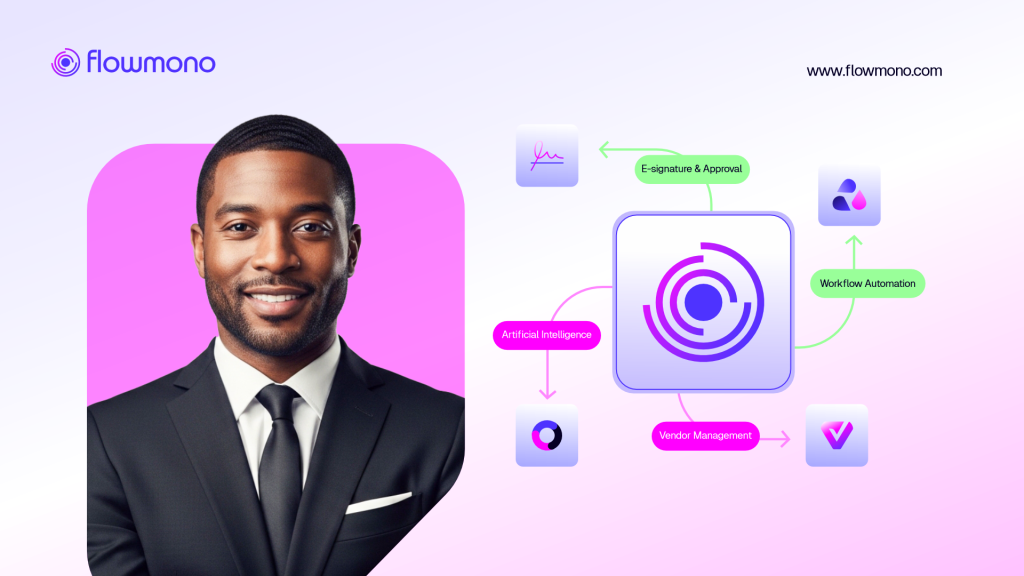
Flowmono’s architecture is a direct response to that gap. Each product in its suite is designed around a single operational thesis: the specific moment in a workflow where unnecessary friction breaks concentration and kills forward momentum.
This operational approach is called Intent-Based Work. By allowing our software to automate standard background decisions, we keep your people focused on execution. The result is a measurable Cognitive Dividend: your team recovers hours of lost time, shifting their attention away from administrative friction and back to core business drivers.
Where most enterprise platforms compete on feature volume, Flowmono Automate competes on restraint. The absence of configuration overhead and excessive menus is not a product limitation. It is a strategic position. Domain expertise is built into the product from day one, which means teams are not customising their way to utility. They arrive there on day one.
Software Must Now Earn Its Keep
The per-seat model was built on a comfortable fiction: that access to a tool was the same as value from it. For decades, enterprise buyers counted licences, not outcomes. Vendors grew by adding seats and features, rarely by demonstrating measurable impact on the actual work being done.
That fiction is becoming harder to sustain. A growing number of vendors are restructuring their commercial models around results rather than access. Intercom’s Fin AI charges $0.99 only when a customer issue is fully resolved. Salesforce’s Agentforce launched at $2 per completed conversation rather than per user licence. These are not isolated pricing experiments. They are commercial signals that the market is beginning to hold software accountable for what it actually delivers.
The implication for how enterprise software is built is significant. A vendor pricing for outcomes cannot afford unnecessary complexity. Every redundant configuration screen, every underused feature, every menu that slows the work down becomes a liability rather than a differentiator. The same scrutiny now applies across the stack: the question is no longer what a platform can theoretically do. It is whether it reliably makes the work better.
Agentic AI is sharpening this accountability further. Autonomous agents now handle approvals, route documents, and manage workflows without waiting for a human to operate them step by step. Bloated platforms with legacy interfaces are not just inconvenient in this environment. They are structurally unable to absorb the next generation of intelligent automation. The platforms that will carry enterprise operations forward are those built with enough focus and clarity to integrate AI at the architecture level, not bolt it on afterward.
The Mandate for 2026: A Call to Focus
Picture that same knowledge worker, six months into a rationalized stack. The morning still brings complexity, because the work is complex. But the tools no longer add to it.
What that worker gets back is the cognitive condition required to do work that actually matters: sustained attention, clear decision-making, and the kind of focused output that no amount of software spending can manufacture on its own. This is what Cognitive ROI looks like in practice. Not a line item on a dashboard. A person arriving at the end of the day with something real to show for it.
The mandate for 2026 is not complicated. Audit every tool in the stack against a single question: does this create focus, or does it fragment it? Every application that cannot answer that question in the user’s favour is not a safety net. It is a tax.
Ready to see what intent-based work infrastructure looks like in practice? Request a demo and explore how Flowmono’s focused product suite reduces operational friction without sacrificing control.
