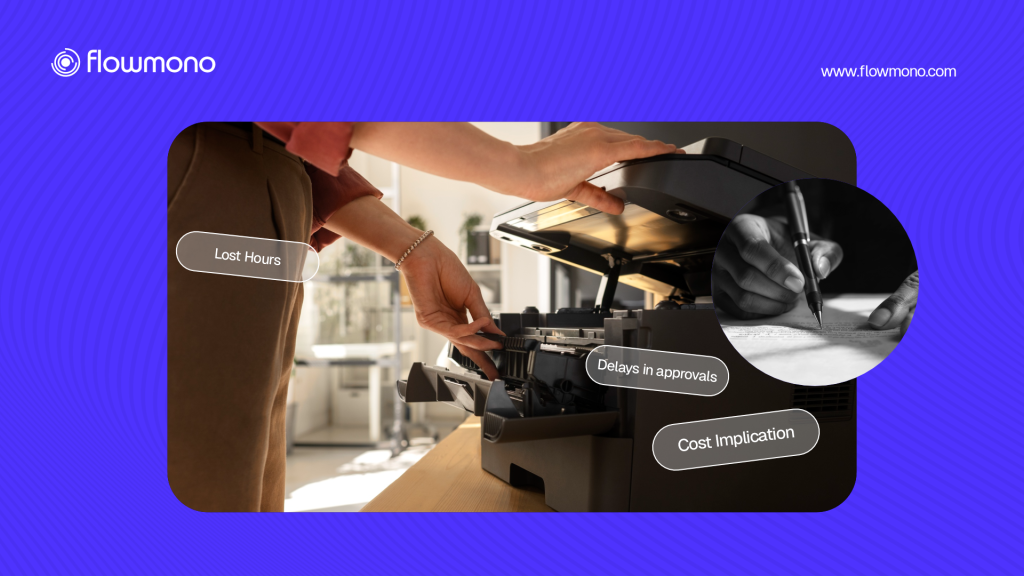
The print-sign-scan cycle has survived every wave of digital transformation. Understanding why is the first step to ending it.
The Loop That Should Not Exist
The meeting is over. The document has been drafted, reviewed, approved in principle, and sent for signature. It arrives in the executive’s inbox as a PDF. The executive prints it, picks up a pen, signs it, walks to the scanner, scans it back to PDF, and emails it to whoever sent it.
This sequence describes a 1998 workflow. It is also the workflow that a significant number of C-suite and senior executives still use in 2026, across industries as digitally advanced as banking, law, and financial services. The printers outside executive offices in high-rise buildings across Lagos, Nairobi, London, and Dubai exist for this reason.
The question is not whether this is inefficient. It obviously is. The question is why it persists, what it actually costs, and what a realistic replacement looks like for an executive who prefers to sign with a pen.
| The print-sign-scan cycle is not a technology problem. It is a preference and trust problem. The solution has to respect both. |
What It Costs: The Numbers
According to Scanse’s 2025 Office Printing Statistics, the average annual cost of office printing per employee is $725, covering paper, ink, toner, and energy. For executive-level staff who print substantially more than the average worker, this figure is conservative. The same research notes that 45 to 65 percent of all printed documents are discarded on the same day they are printed. In the context of document signing, the discarded printout is the printout itself, after the scan completes.
The direct cost of printing is the smaller part of the equation. The larger cost is time. The print-sign-scan sequence requires the executive to physically move between three locations (desk, printer, scanner), manage the paper output, and return a file to the workflow that is now a scanned image rather than the original structured PDF. The metadata the original file contained, including version history and any digital annotations, has been discarded in the scanning process.
A 2025 report from the OPEX Corporation on paper-based workflow costs found that associated paper costs including storage, copying, and postage total roughly 30 times the actual purchase cost of the paper itself. The full operational cost of maintaining a print-based signing workflow at the executive level is substantially higher than the invoice for paper and toner suggests.
Why Executives Persist With It
The honest answer is not inertia, though inertia is a factor. Executives who prefer handwritten signatures often have two substantive reasons: they trust the pen-on-paper interaction as an intentional, deliberate act, and they have concerns about whether a digital signature carries the same legal weight as a wet ink signature.
Neither concern is irrational. The deliberateness concern is real: clicking through a signing screen can feel less weighty than physically picking up a pen and signing. The legal concern, while addressable, is persistent because it has never been clearly resolved for many senior professionals.
On the legal question, the answer is clear. Under the US ESIGN Act and UETA, as confirmed by Docusign’s legal reference documentation, electronic signatures carry exactly the same legal weight as handwritten wet ink signatures when four conditions are met: intent to sign, consent to conduct business electronically, association of the signature with the record, and proper record retention. Flowmono’s architecture satisfies all four. The legal concern is a resolution problem, not an evidence problem.
The Deeper Problem: What Gets Lost in the Scan
Beyond cost and time, the print-sign-scan cycle creates a structural problem for document governance that is rarely discussed at the level where it matters: the audit trail.
When a document is printed and scanned, the resulting file is a pixel image of the original. It is not the original. Version information is lost. Any digital watermarks or metadata in the original PDF are not present in the scanned output. The audit trail inside the document workflow now has a gap: the document entered the signing stage as one file and returned from it as a different file.
In ordinary operations, this gap is invisible. In a regulatory examination, a legal dispute, or an internal investigation, it becomes material. The question an auditor asks is: is this the document that was approved? The scanned image cannot answer that question with the same certainty as a document that never left a governed digital workflow.
| The print-sign-scan cycle does not just cost money and time. It creates a verifiable gap in the document’s chain of custody that conventional workflows cannot close. |
What a Credible Alternative Looks Like
The reason the print-sign-scan cycle persists is partly that the available alternatives have not felt like genuine equivalents of the handwriting experience. Clicking a signature field does not feel like signing. Typing a name into a signature box is not the same cognitive or physical act as picking up a pen.
The Flowmono Freehand Signer is built around a different premise: the iPad with Apple Pencil, at under 16 milliseconds of latency, replicates the physical experience of signing closely enough that the preference objection loses its force. The executive picks up the stylus. They write their signature. The stroke appears on screen as it is made, without perceptible delay. The document is submitted. The audit trail records the event with a timestamp and identity link.
The Freesigner configuration specifically addresses the executive use case. An Organisation Admin designates the executive’s email as a Freesigner address. When the executive receives a document, the annotation tool activates automatically. They sign wherever they choose, the way they choose, without needing anyone to have configured a signature field in the right place beforehand.
The print-sign-scan cycle will not end because someone tells executives to stop doing it. It will end when the digital alternative is indistinguishable from the physical one. Try the Flowmono Freehand Signer and see what that experience actually looks like.
