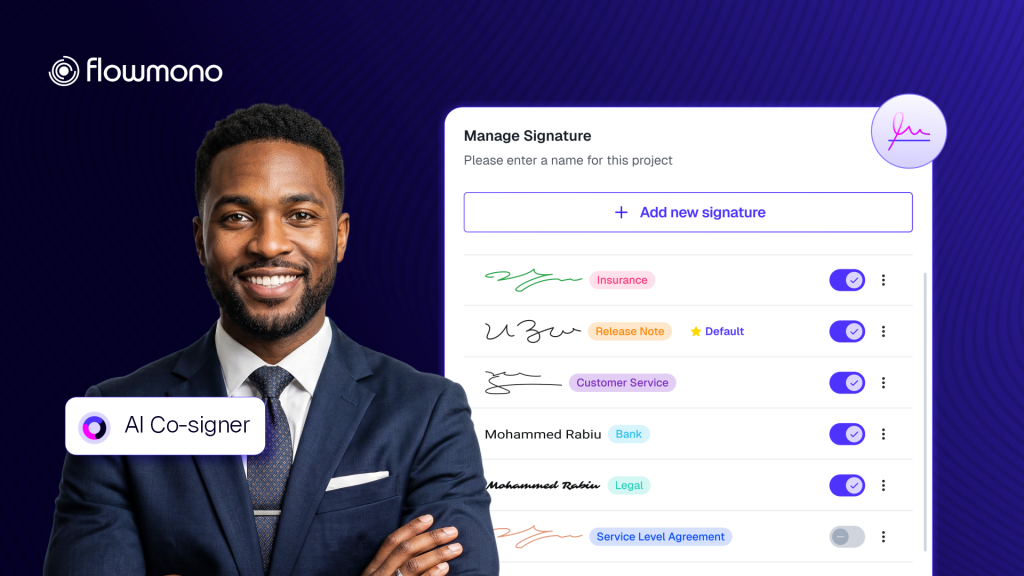
Every industry has its own document vocabulary. Contracts, claims, purchase orders, loan agreements, policy acknowledgements. Each one has a signing convention your team already applies. Signature profiles capture that convention once and apply it every time.
Behind every AI capability is a mechanism. The mechanism is where the real work happens, and where most explanations stop too early.
AI Co-Signing does not sign documents for you. What it does is much more precise: it learns which signature belongs on which document, applies that knowledge automatically when a recognized document arrives, and leaves the final decision with you. The mechanism that makes this possible is the signature profile.
Understanding how profiles work is not just a product education exercise. It is the difference between a feature you set up once and forget, and one that progressively transforms how your team handles the most document-intensive parts of its operation.
The Problem That Profiles Solve
Document signing is not uniform across an organization. A procurement officer signing a vendor contract is applying different standards than when she signs an internal purchase authorization, a supplier compliance acknowledgement, or a change order. Each document type carries its own context, its own formality level, and its own organizational conventions.
Currently, every one of those distinctions is held in the team member’s memory and re-applied manually with every signing event. The right signature for the right document is a judgment that is exercised hundreds of times per month, sometimes correctly, sometimes not.
Organizations using contract lifecycle management platforms report 80 percent faster contract cycle times and 25 to 30 percent lower administrative costs compared to manual tracking. The time savings do not come from signing faster. They come from eliminating the selection overhead that surrounds every signing event.
When that selection overhead occurs at volume, under time pressure, across a team handling multiple document types simultaneously, errors accumulate. The wrong signature is applied to the wrong document. The correction requires a re-signing. The re-signing requires the counterpart’s time. The delay compounds. The cost is real and almost never attributed back to the signing process itself.
What a Signature Profile Is
A signature profile is a stored configuration that captures everything about how a specific type of document should be signed: which signature format to use, for which document category it applies, and what organizational standard it represents. What this means is that a user can create multiple profiles, each mapped to a distinct document category.
The profile is not a template. It is not a saved image of a signature that gets pasted in. It is an intelligent rule that the platform references when a document arrives, checks against the document’s category, and applies to the appropriate fields automatically before the user opens the document to review.
Think of it as writing a decision once instead of making it repeatedly. The logic that previously lived in your team member’s head, the knowledge that external vendor agreements use the formal signature, that internal approvals use initials, that compliance documents carry the department head’s authorization format, that logic is transferred to the platform. Once. And then it runs automatically for every document that matches.
How to Configure a Profile: Two Simple Steps
The configuration process is designed to be completed in a single session. It does not require technical expertise. It requires the organizational knowledge your team already has about how its documents should be handled.
1. Create your signature or upload an existing one
For instance, within Flowmono, you define the signature formats your organization uses. Your formal signature for external-facing agreements. Your initials for internal routing. A specific sign-off format for regulated documents that require a particular authorization standard. Each format is created once and stored in the platform.
2. Map Categories to your signature
Categories are the classification system the platform uses to recognize incoming documents. So, for each signature you create or upload, you assign a document category which makes the system automatically apply that signature when a matching document is received. You can also select more than one document category for each signature when setting it up.
WHAT HAPPENS NEXT
Once the mapping is saved, Co-signer references it every time a document is opened. If a document matches a known category, the correct signature is already in place. If it does not match, the user’s default signature will be used, but he or she will still have the final say as to whether or not to submit. This preserves the user’s full oversight over unrecognized document types.
What This Looks Like Across Industries
Signing is not the only process in an industry. It is one step within a much larger operational chain. The value of signature profiles becomes clearer when you see them in the context of the full document workflows they sit inside.
🏦Banking and Financial Services
Recurring document types: Loan origination documents, credit facility agreements, account-opening forms, AML compliance declarations, mortgage deeds, trade finance instruments, and correspondent banking agreements
The profile opportunity: A corporate banking relationship manager processing thirty loan packages per month handles at least six distinct document types, each with its own regulatory signing standard. Profiles eliminate the selection decision at every stage of the loan lifecycle, from origination through disbursement.
Context: Banks that automate document stages of loan origination reduce processing times by up to 50% (Feathery Research, 2024)
📋 Insurance
Recurring document types: Policy issuance documents, claims assessment authorizations, reinsurance treaty agreements, regulatory compliance submissions, broker commission confirmations, surveyor appointment letters, and settlement discharge forms.
The profile opportunity: An insurance operations team managing the FNOL-to-payment lifecycle touches multiple document categories at each claims stage. Profiles allow the adjuster’s authorization, the surveyor’s sign-off, and the settlement discharge to each carry the correct format without manual selection at any step.
Context: 74% of insurers still rely on legacy systems for critical processes, creating manual workflows that delay claims (Lumenalta, 2025)
🏗️ Construction and Infrastructure
Recurring document types: Subcontractor agreements, variation orders, completion certificates, milestone payment authorizations, site inspection sign-offs, health and safety compliance documents, and client handover records
The profile opportunity: A project director on a large infrastructure engagement may oversee signing events across twelve distinct document categories simultaneously across multiple subcontractors. Profiles ensure that the formal project director signature, the site supervisor’s sign-off, and the compliance acknowledgement each appear correctly without the project team manually verifying the format at each occurrence.
Context: 98% of construction projects face delays, with average project duration extending 37% beyond original projections (Buildern, 2024)
🏥 Healthcare and Pharmaceuticals
Recurring document types: Vendor supply agreements, procurement frameworks, clinical trial authorization documents, equipment maintenance contracts, regulatory submission cover letters, and inter-institutional data sharing agreements
The profile opportunity: A hospital procurement department managing equipment vendors, pharmaceutical suppliers, and service contractors operates across document types with different regulatory and organizational signing requirements. Profiles separate clinical authorization from commercial authorization from compliance sign-off, automatically.
Context: US hospitals lose $25.7 billion annually from unnecessary supply chain spending, with manual procurement processes a primary contributor (Navigant Survey)
⚖️ Legal Operations
Recurring document types: NDA agreements, engagement letters, matter authorization documents, regulatory filing cover pages, settlement agreements, litigation hold confirmations, and external counsel instruction letters
The profile opportunity: A legal operations manager handling 300 documents per month across multiple practice areas uses a different signing authority depending on whether the document is an engagement letter from a partner, an internal matter authorization from an associate, or a compliance acknowledgement from a paralegal. Profiles keep those distinctions consistent without requiring manual verification at each event.
Context: AI can complete a contract review in 26 seconds compared to 92 minutes for a human reviewer (SuperLegal AI research, cited in ContractSafe 2025)
🔧 Manufacturing and Supply Chain
Recurring document types: Purchase orders, goods receipt confirmations, quality inspection certificates, supplier qualification documents, incoterms agreements, and supplier development plans
The profile opportunity: A supply chain director overseeing 200 active vendors processes signing events across at least eight distinct document categories per procurement cycle. Profiles ensure that the commercial sign-off, the quality authorization, and the compliance acknowledgement each carry the appropriate format without manual selection at high volume.
Context: RFQ processing time reduced by 85% (from 4 weeks to 4 days) through AI-assisted procurement automation (Nexocode case study)
The Compounding Effect Over Time
Organizations using electronic signature platforms reduce document turnaround time by up to 80 percent. That improvement reflects the shift from paper to digital. Signature profiles represent the next layer: the shift from digital but manual to digital and intelligent.
The compounding effect is worth understanding. When profiles are configured for your most frequent document categories, the time savings occur with every document that matches those categories from that point forward. A procurement team processing one hundred vendor agreements per month saves the selection overhead on every one of them. A legal operations team processing three hundred documents per month saves it on every recurring document type. The investment of configuration is made once. The return accumulates indefinitely.

Source: Forrester Research (via GetAccept, 2025)
That figure captures what happens when digital replaces paper. Signature profiles drive the next improvement: eliminating the manual overhead that persists inside the digital process.
The configuration session that sets up your signature profiles is an investment measured in minutes. The return is measured in the aggregate of every signing event that follows it.
Set Up Your Signature Profiles on Flowmono
AI Co-Signing is live on Flowmono now. Log in, create your signature formats, define your document categories, and map them. The next document that arrives in a recognized category will open with the correct signature already in place. No repeat configuration. No manual selection from that point forward.
