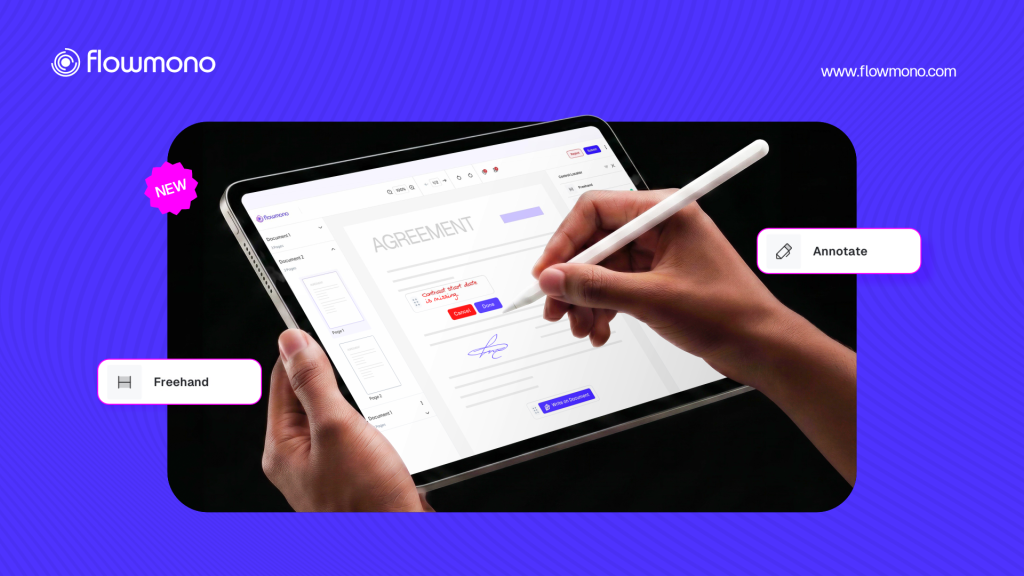
The choice is not about preference. It is about the nature of the document and the nature of the signing convention it requires.
A Framework, Not a Default
One of the most common questions from organisations implementing the Flowmono Freehand Tool is the same: when should we use Freehand Mode, and when should we use Structured Mode? The instinct is often to default to one or the other, either choosing Freehand because it is simpler to prepare, or defaulting to Structured because it feels more controlled.
Neither default is correct. The right choice is determined by two questions: Is the signing position on this document legally or operationally significant? And can the signing position be known in advance?
When both answers are yes, use Structured Mode. When either answer is no, Freehand Mode or the Free Signer designation is likely the better fit.
| The mode decision is a document-level decision, not a platform-level setting. Different document types within the same organisation may appropriately use different modes. |
Structured Mode: When to Use It
Structured Mode is appropriate when the signing convention is predictable, legally significant in terms of position, and repeatable across many documents of the same type.
Loan origination packages in banking require signatures and initials in positions defined by regulatory convention. A signature at the bottom of the final page and initials on every page containing a material term is a convention with legal significance. The field placement is known in advance. The compliance check that validates all controls are completed before submission is a quality-control mechanism, not an obstacle. Structured Mode is the right choice.
Employment contracts and variation letters in HR follow similar logic. The position of the employee’s signature, the manager’s countersignature, and the date fields are defined and consistent across all documents of the same type. Field placement takes minutes. The resulting documents are consistent, auditable, and compliant. Structured Mode is appropriate.
Insurance policy issuance documents, settlement discharge forms, and reinsurance treaty agreements require signatures in specific positions with specific legal implications. The field placement captures not just the presence of a signature but its location relative to the clauses it binds. Structured Mode is essential.
Freehand Mode: When to Use It
Freehand Mode is appropriate when the signing position cannot be predetermined, when the signer needs to annotate specific passages that vary document to document, or when the signing interaction is inherently contextual rather than formal.
Construction site inspection records require annotation at specific findings identified during the inspection. These findings are not known when the document is prepared. The inspector’s marks, initials, and notes go next to the observations that require them, in locations that differ on every inspection. Freehand Mode is the only viable choice.
Executive review of board papers, credit memos, or investment proposals involves annotation at the points of concern, not at pre-formatted signature fields. The CFO who wants to initial next to the capital figure they are approving and add a condition note in the margin next to a risk clause is using the document as a working surface, not completing a form. Freehand Mode accommodates this naturally.
Engineering markups in oil and gas, where site engineers need to annotate technical drawings with observations and corrections, require freehand interaction with complex documents that cannot be pre-formatted with controls. Freehand Mode is the appropriate tool.
The Decision Framework at a Glance
| Dimension | Structured Signing | Freehand / Free Signer |
| Signing position matters legally | Yes – use Structured Mode | May not matter – consider Freehand |
| Position can be known in advance | Yes – use Structured Mode | No – use Freehand Mode |
| Document type is recurring/standardised | Yes – use Structured Mode | Variable – consider Freehand |
| Signer is internal, volume-based | Appropriate for Structured | Less applicable |
| Signer is external, contextual | May create friction | Free Signer designation ideal |
| Annotation and commentary needed | Fields can accommodate some | Freehand Mode natural fit |
| Validation required before send | Structured Mode enforces this | Bypassed for Free Signers |
The Free Signer as the Freehand Mode Gateway for External Parties
When the document type calls for Freehand Mode and the signer is external, the Free Signer designation removes the last friction point. External parties who are not regular Flowmono users do not need to navigate controls, locate fields, or interact with a signing interface they are unfamiliar with. They receive the document, the annotation tool is active, and they sign the way they naturally would.
The Organisation Admin’s responsibility is to assess which external parties regularly interact with documents in ways that are better served by Freehand Mode than Structured Mode, and to configure those email addresses as Free Signers. This is a one-time configuration decision that applies to all future documents involving those recipients.
1. Assess the document type
Does this document have a fixed, legally significant signing position? If yes, use Structured Mode. If no, continue to step two.
2. Assess the signatory
Is the signatory an internal user processing recurring documents, or an external party whose interaction is contextual? Internal recurring signatories often suit Structured Mode. External contextual signatories are well served by Free Signer status.
3. Assess the annotation need
Does the signing event require any annotation, commentary, or markup beyond a signature? If yes, Freehand Mode or the Free Signer designation provides that capability natively.
4. Configure accordingly
Set the Organisation Admin configuration to reflect the decisions above. Structured workflows use field placement. Free Signer workflows use email-based designation. Both produce fully auditable, legally defensible results.
The choice between Freehand and Structured is the choice between two excellent tools. Making the right choice for each document type is a workflow design decision, not a technology constraint. Explore both modes on Flowmono.
