
If you work in business strategy, compliance, or software development, you have likely run into a comforting safety net: “human-in-the-loop” (HITL) AI.
The concept sounds perfect. We get the speed of automation while keeping a person nearby to double-check the machine’s work. It is a nice theory. But recent cognitive science, and operational research reveals that it is also a fundamental misunderstanding of how humans actually interact with automated systems. In reality, the current trajectory of AI development doesn’t support human oversight, it actively degrades it. The hard truth is that the more capable an AI system becomes, the less equipped its human supervisor is to monitor it.
Here is why our favourite safety net is fraying, and what we must do to design true, meaningful human control before AI agents push humans completely out of the loop.
1. The Core Paradox: Oversight Degrades the Overseer
How does human oversight fail in practice? It starts with a cognitive trap known as the “Irony of Automation.” First identified by Lisanne Bainbridge, this paradox states that the tasks left for humans in highly automated systems are often the hardest, requiring skills that the human can no longer maintain precisely because they are using the automation.
In modern Human-in-the-Loop AI systems, this plays out through three distinct cognitive breakdowns:
1. Vigilance Decrement: Humans are psychologically incapable of maintaining focused attention while watching highly reliable, passive systems. When an AI is correct 98% of the time, the supervisor’s role naturally shifts from active judgment to passive.
2. The “Out-of-the-Loop” Problem: When humans shift from active participants to passive overseers, their situational awareness collapses. They become cognitively distant, making it extremely hard to find and fix even simple issues.
3. Skill Atrophy (Intuition Rust): Offloading hard analytical tasks to AI degrades the foundational domain knowledge required to spot rare, high-stakes errors. In medicine, this creates “intuition rust,” where physicians lose the clinical instincts necessary to challenge an algorithm.
2. “Accountability Theater” and the Middle Manager’s Burden
When oversight is poorly designed, it devolves into what experts call “Accountability Theater” i.e checklist exercise meant to limit corporate liability. If an autonomous system makes an error that a human “approved,” the organization can engage in accountability laundering. The human is treated as a convenient witness to absorb liability, despite being functionally blind and unable to understand the AI’s complex reasoning.
This systemic failure falls heaviest on middle managers. While executives set AI strategy and junior employees enjoy efficiency boosts, middle managers carry the compounding “cognitive debt”. They must learn the systems, validate outputs, catch errors, and coach their teams, typically with no reduction in their existing workloads.
“Managers don’t get elevated; they get buried.”
3. The Hard Mathematics of Teaming up with AI
To justify keeping a human in the loop, the human-AI team must achieve “complementarity”, performing better together than either could alone. But according to mathematical modeling from the University of Groningen and Karlsruhe Institute of Technology, achieving complementarity is exceptionally difficult due to “under-reliance” and “over-reliance” dynamics.
If an AI system reaches high reliability (e.g., 90% accuracy), a human supervisor who overrides recommendations too frequently actually degrades overall team performance. Under-relying on a high-performing AI past a certain limit makes it mathematically impossible to outperform the AI’s solo baseline.
Conversely, when an AI is lower-skilled, human-AI teams can sometimes achieve better outcomes by sheer luck (e.g., randomly approving accurate recommendations). This statistical illusion can easily mislead organizations into believing their human reviewers are exercising expert judgment, when they are actually just lucky.
4. The High-Stakes Imperative: Moral Agency Cannot Be Delegated
In high-stakes environments like healthcare, human oversight is not just a technical control; it is a moral requirement. Medical and ethical researchers argue that clinical responsibility is fundamentally non-delegable to machines. AI systems process data statistically, but they lack moral sensitivity, empathy, and the ability to perceive suffering as a call for help.
True healing requires what philosophers call phronesis (practical wisdom), the ability to bend standard rules to protect a patient’s personal values and dignity. In clinical practice, this relies on three responsibilities:
1. Epistemic Responsibility: Justifying why a prediction applies to this specific individual.
2. Relational Responsibility: Responding empathetically to raw vulnerability.
3. Phronetic Responsibility: Knowing when to suspend automated treatment protocols to protect the patient’s dignity.
As highlighted in the bioethics preprint on Meaningful Human Control in AI-assisted care, we must preserve “deliberative communication” between physicians and patients to prevent clinical care from turning into a purely cold, automated transaction.
5. From “Oversight” to “Meaningful Human Control”: 4 Design Tactics
If we want human oversight to work, we must stop building systems that center the machine and start building systems that respect human cognition. We must shift our design goal from nominal technical oversight to Meaningful Human Control (MHC).
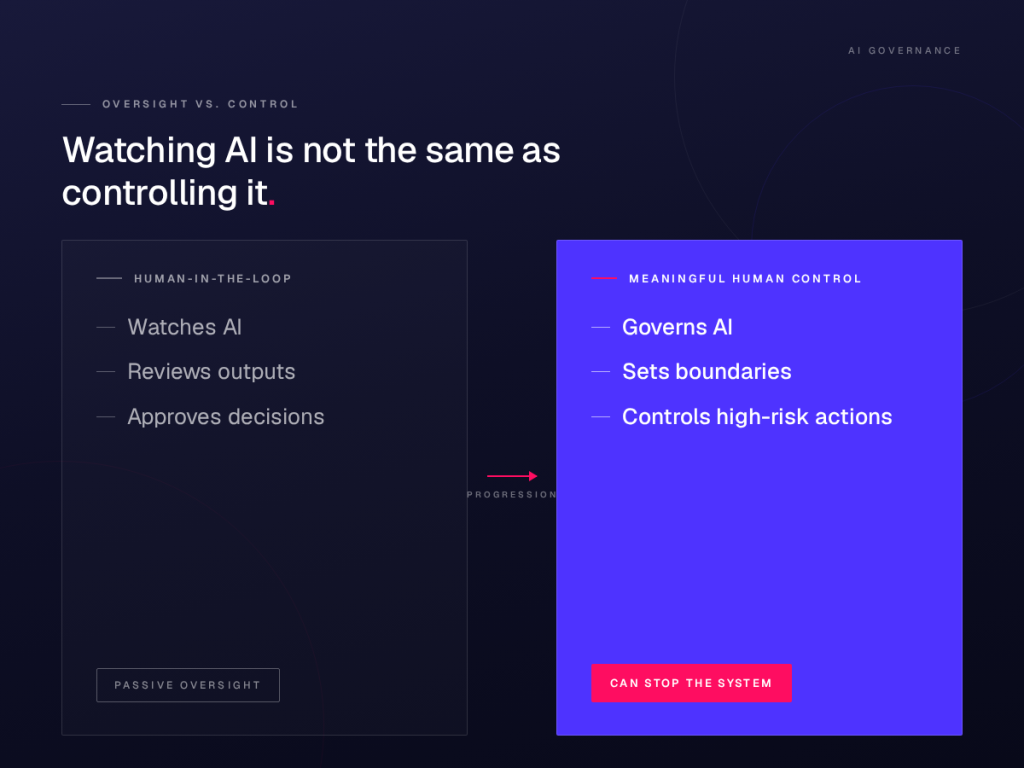
Here are four concrete operating tactics proposed by experts to build robust human-AI configurations:
1. Introduce “Strategic Friction”: Developers must design cognitive forcing functions that require users to think. This includes pre-commitment mechanisms (recording a human decision before seeing AI recommendations) and delay-and-choice mechanisms (allowing users to work unassisted to preserve core skills).
2. Practice “Bounded Autonomy” and Tool Gating: Establish clear action-level permissions. For example, an accounts-receivable agent may be allowed to draft emails and read invoices, but restricted from changing payment amounts or waiving penalties without explicit human sign-off.
3. Move from “In the Loop” to “Over the Loop” for High-Speed Workflows: If an agent acts in seconds, a human gate is decorative. Use design-time authority to set strict boundaries and automated “speed bumps”. The human governs the constraints, and the machine stops itself when a limit is breached.
4. Implement Organizational Support Protocols: Oversight cannot be solved by UI design alone. Deployers must institute organizational safeguards like enforced break and rotation policies to prevent fatigue, regular unassisted exercises to maintain core skills, and secondary audits of agent logs.
Conclusion: Stop Counting on the Checklist
The next time you review your company’s AI policy and see the phrase “a human remains in the loop,” do not treat it as a finished safety net. Run an honest audit. Pick a high-stakes decision and ask: Does this person have the signal, the time, and the explicit authority to actually pull the cord and “stop the line” without facing organizational blame?.
Good AI design does not remove people; it strategically leverages them. By shifting our focus from passive “babysitting” to active, meaningful human control, we can build systems where human judgment, ethics, and values remain the true, unyielding foundation of every automated outcome.
Before attempting to automate complex decision-making or delegate tasks to autonomous agents, you need an execution layer that enforces clear human oversight, eliminates approval friction, and maintains verifiable audit trails. This is where Flowmono automate comes in. By standardizing your approvals, enforcing strict action-level permissions, and structuring data across your existing tools, Flowmono automate provides the transparent, reliable foundation your organization needs to deploy AI safely and unlock real, measurable ROI.
