When a new employee joins your company, onboarding usually starts with the obvious things: signing documents, filling out forms, getting access to tools, and completing HR paperwork.
Most organizations treat these tasks as the onboarding process itself. As long as everything gets signed and submitted, they assume the new hire is off to a good start.
But paperwork isn’t the real onboarding challenge. It’s simply the most visible symptom of a much bigger problem: there’s often no system designed to help new employees feel prepared, connected, and productive from day one.
When that foundation is missing, the costs show up everywhere, in slower ramp-up times, lower engagement, compliance gaps, and employees who never quite reach their full potential.
The Checklist Trap
Most onboarding playbooks are transactional: sign the handbook, submit bank details. Done.
This checklist mindset misses the point entirely. Onboarding isn’t paperwork. It’s a new employee’s first real experience of how your company actually operates.
The data backs this up. Structured onboarding programs lift new-hire retention by as much as 82 percent, according to benchmarking research from Brandon Hall Group. On the flip side, Gallup finds only 12 percent of employees think their company handles onboarding well. A clumsy, fragmented process shows up immediately, and new hires disengage before their first real project even starts.
Treating onboarding as first-week admin, instead of a managed journey, tells a new hire exactly how much the company values their time.
Why Remote Teams Feel It Twice as Hard
In a physical office, broken processes hide behind proximity. An HR coordinator walks a form to an executive’s desk for a same-day signature. A mistake gets fixed with a two-minute hallway conversation. Nobody notices the process was disjointed to begin with.
Distributed teams don’t get that safety net. Every informal workaround disappears, and the fragmented tool tax shows up in full.
Now picture a new hire, on unstable data, trying to download a heavy PDF, print it, sign it, scan it, and re-upload it, across four separate approvals from IT, Legal, Finance, and HR. That isn’t onboarding. That’s an obstacle course, and it’s the reason so many new hires feel behind before their first week ends.
The average enterprise runs onboarding across a patchwork of disconnected tools: e-signature apps, document converters, email threads, spreadsheets. Few of them talk to each other. Every handoff between systems is a place where a form goes missing, a signature gets lost, or a new hire waits an extra day for access they should have had on day one.
The Compliance Blind Spot
Onboarding forces HR to handle some of the most sensitive data a company touches: national ID numbers, bank verification details, tax identifiers, home addresses.
Under the Nigeria Data Protection Act, organizations must secure that data and maintain an audit trail, and larger companies are required to file compliance returns with the Nigeria Data Protection Commission. An unencrypted email attachment doesn’t meet that bar, no matter how routine it feels.
Nigeria’s legal framework has also caught up with digital signatures. The Evidence Act (Amendment) Act, 2023 recognizes electronic signatures in Nigerian courts. But there’s a real difference between a secure e-signature, one with an audit trail, timestamps, and identity verification, and a scanned image pasted onto a PDF. Only the former holds up when a signature is disputed.
What Good Onboarding Infrastructure Looks Like
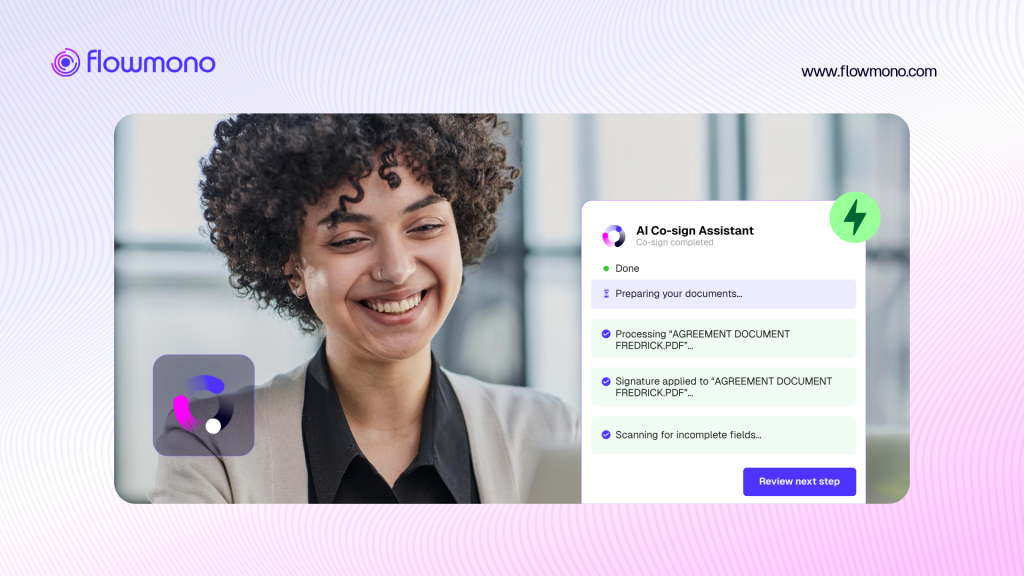
Progressive HR teams are replacing disconnected point tools with one governed workspace. When a candidate signs their offer letter, that single action can trigger everything downstream: IT provisions system access, Finance sets up payroll, and the new hire’s manager gets a calendar invite for their first one-on-one. No manual handoffs, no re-keyed data. Flowmono’s guide to modern HR automation breaks down what that setup looks like in practice.
Multi-signatory documents, employment contracts, NDAs, compliance forms, need the same rigor. A platform that authenticates every signatory, timestamps every action, and locks the document against tampering after execution gives you a record that satisfies both an NDPC auditor and a courtroom. Here’s how that process works when several people need to sign the same document.
None of this replaces the human side of onboarding. It removes the paperwork so HR can spend that time on what a document can’t do: welcoming someone properly, explaining how the team actually works, making the first week feel like the start of something instead of a form to fill out.
The Payoff
Cut document turnaround from weeks to minutes, and the effect compounds. New hires reach full productivity faster. Cross-departmental approval bottlenecks disappear. Compliance stops being a fire drill before every audit and becomes a natural byproduct of how the system runs.
This matters more for scaling businesses than it looks on paper. Every hire you make while running onboarding on email threads and PDF attachments is a fresh chance for something to fall through the cracks, a missed access request, a signature nobody can verify, a compliance gap nobody notices until it’s audited. Fix the infrastructure once, and every hire after it gets faster, not just the next one.
Onboarding is the first real look an employee gets at how your company operates. An empty inbox and a stack of PDFs tells them one story. A system that already knows their name, their role, and their first meeting tells them another.
Ready to see what a unified onboarding workspace looks like for your team? Explore Flowmono and build a first day worth showing up for.
