Let’s be honest: most Nigerian businesses don’t actually have an execution problem. They have a hand-off problem.
You’ve likely seen it happen in your own organization. A high-value contract sits in a manager’s email inbox for four days while they’re “out of office.” A crucial vendor payment stalls because physical signature sheets are traveling between branches in Victoria Island and Ikeja. A promising job candidate accepts a competitor’s offer because your internal HR team took two weeks to route a paper offer letter for approval.
In a business environment defined by shifting economic realities, volatile FX rates, and fierce competition, administrative latency is a silent profit killer.
While many organizations claim to be “digitized” because they turn paper forms into PDFs, the most agile enterprises across Nigeria are quietly making a far bigger leap: they are replacing manual hand-offs entirely with end-to-end workflow automation.
In this guide, we strip away the corporate jargon and look at what true workflow automation looks like in Nigeria today, why localized infrastructure matters, how leading industries are using it to cut turnaround times by 80%, and how your business can eliminate paper drag to scale sustainably.
What is Workflow Automation?
Workflow automation is the practice of using rule-based technology to orchestrate, execute, and monitor routine business processes without relying on manual human intervention.
Instead of manually routing documents via email, chasing managers for signatures, or re-keying data into spreadsheets, automated workflows handle the movement of data and tasks between systems and people seamlessly.
An end-to-end automated workflow typically unites four key stages:
- Intake: Capturing structured data via dynamic digital forms or system triggers.
- Conditional Routing: Automatically directing requests to the right decision-makers based on pre-set rules (e.g., routing approval to a Senior VP if an amount exceeds ₦5,000,000).
- Execution: Securing legally binding authorizations through integrated e-signatures.
- Integration: Automatically updating core systems (ERP, CRM, or core banking engines) without manual data entry.
┌─────────────────┐ ┌─────────────────────┐ ┌──────────────────┐ ┌─────────────────┐
│ 1. SMART INTAKE │ ───> │ 2. DYNAMIC ROUTING │ ───> │ 3. E-SIGN EXEC │ ───> │ 4. AUTO-UPDATE │
└─────────────────┘ └─────────────────────┘ └──────────────────┘ └─────────────────┘
Captures data via Applies approval rules Secures legal sign-offs Updates ERP / CRM
digital forms. & escalations. cryptographically. automatically.
The True Cost of Manual Processes in Nigerian Businesses
Many organizations operate under the assumption that manual handoffs are just the “cost of doing business.” However, when you audit the true impact of paper-heavy or disconnected processes, the hidden costs become clear:
i. Administrative Latency: A loan application that could be processed in 15 minutes takes 5 business days due to manual review chains.
ii. Operational Blindspots: Management lacks real-time visibility into where bottlenecks exist or which department is delaying critical approvals.
iii. Compliance & Audit Vulnerabilities: Informal approval channels (like WhatsApp messages or unverified email threads) fail under legal scrutiny and regulatory audits.
iv. Foreign Exchange (FX) Drag: Many African companies attempt to solve these issues using foreign software tools billed in USD, exposing their operating budgets to unpredictable FX fluctuations.
Why Localized Infrastructure Matters for Nigerian Enterprises
While global point solutions exist, adopting enterprise software in Nigeria comes with distinct requirements that off-the-shelf foreign tools often overlook:
1. Regulatory Compliance & Data Sovereignty
Regulated sectors—such as Banking, Insurance, Energy, and Healthcare—must comply with strict local and international data governance frameworks, including the Nigeria Data Protection Act (NDPA) and GDPR. Workflow systems must provide audit-ready, tamper-evident cryptographic logs for every decision made.
2. Predictable Naira-Denominated Economics
Software licensing shouldn’t double overnight due to currency devaluation. Utilizing localized enterprise platforms ensures predictable technology overhead and keeps operational costs manageable.
3. Closing the IT Talent Gap
With high demand for software engineering talent, business units cannot afford to wait months for IT teams to code custom approval engines. Modern platforms must offer no-code process builders that allow HR, Legal, Procurement, and Finance leads to create and adjust workflows independently.
High-Impact Workflow Automation Use Cases Across Key Sectors
Workflow automation delivers measurable results across diverse industries in Nigeria:
1. Banking, Financial Services, and Insurance (BFSI)
- Digital Account Opening & KYC Validation: Automate customer data capture, identity verification, and compliance checks to open accounts in minutes rather than days.
- Loan Approval Orchestration: Route credit applications dynamically based on risk scores and loan thresholds, dramatically accelerating disbursement times.
- Claims Processing: Streamline insurance claims from initial intake through verification to payout authorization.
2. Human Resources & Corporate Operations
- Employee Onboarding: Compress onboarding timelines from weeks to days by automating offer letter generation, document uploads, policy sign-offs, and IT access provisioning.
- Leave & Expense Management: Replace manual paper forms with automated approval paths that update HR databases in real time.
3. Energy, Utilities, and Infrastructure
- Vendor Onboarding & Procurement: Streamline vendor registration, contract execution, and purchase order approvals.
- Permit-to-Work (PTW) Sign-offs: Eliminate field-to-office delays by enabling mobile-first safety compliance checks and instant sign-offs on location.
4. Real Estate & Property Management
- Lease Agreement Execution: Dispatch tenancy contracts to multiple parties simultaneously with automated follow-ups and status tracking.
- Facility Maintenance Requests: Route tenant maintenance issues directly to approved contractors with built-in financial sign-off limits.
How Flowmono Drives End-to-End Workflow Automation
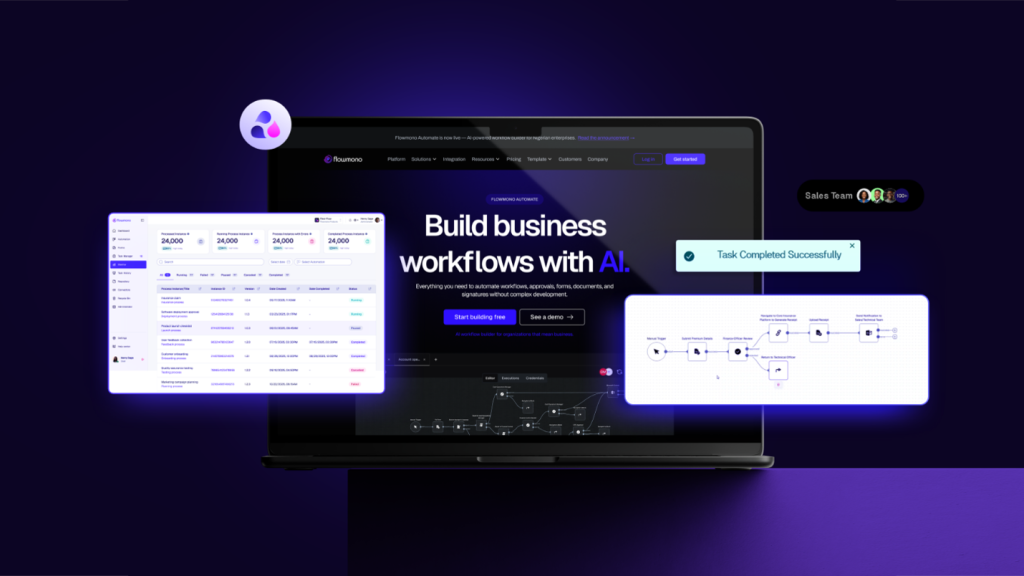
Flowmono is built specifically to address the operational realities of modern African enterprises, combining process orchestration, cryptographic security, and AI intelligence in a unified platform.
┌────────────────────────────────────────────────────────────────────────┐
│ FLOWMONO PLATFORM ARCHITECTURE │
├───────────────────┬───────────────────┬────────────────────────────────┤
│ FLOWMONO E-SIGN │ FLOWMONO AUTOMATE │ FLOWMONO AI │
│ Cryptographic │ No-Code Process │ Contract Analysis & Smart │
│ Digital Signatures│ Orchestration │ Risk Summaries │
└───────────────────┴───────────────────┴────────────────────────────────┘
By connecting every stage of the document and process lifecycle, Flowmono enables organizations to:
- Build No-Code Workflows: Use Flowmono Automate to design, test, and deploy complex approval matrices using a visual drag-and-drop interface.
- Secure Legally Binding Approvals: Execute contracts and authorizations with Flowmono E-Sign, backed by tamper-evident audit trails that comply with NDPA and GDPR standards.
- Leverage Process Intelligence: Utilize built-in AI tools to summarize complex legal agreements, flag compliance risks, and auto-route tasks to appropriate decision-makers.
- Integrate Seamlessly: Connect automated workflows directly into existing ERPs, CRMs, and core banking engines using RESTful APIs.
How to Get Started with Workflow Automation Today
Transitioning to automated workflows doesn’t require overhauling your entire operation overnight. Follow these four practical steps:
- Audit Your Bottlenecks: Identify the single process in your organization that causes the most administrative delays (e.g., vendor onboarding or HR approvals).
- Map the Process Logic: Clearly define inputs, required approvers, escalation rules, and final triggers before setting up software.
- Deploy a No-Code Solution: Start with a focused pilot using Flowmono Automate to build and refine the workflow without heavy software development.
- Measure and Scale: Track metrics like turnaround time reduction and team productivity, then roll out automation across additional departments.
The Bottom Line
Relying on paper trails, scattered email threads, and disconnected point solutions creates unnecessary drag on business growth. Modern organizations are shifting toward unified execution platforms to eliminate bottlenecks, maintain compliance, and improve operational speed.
Ready to transform how your organization works? Get started with Flowmono today and discover how end-to-end workflow automation can accelerate your business operations.
