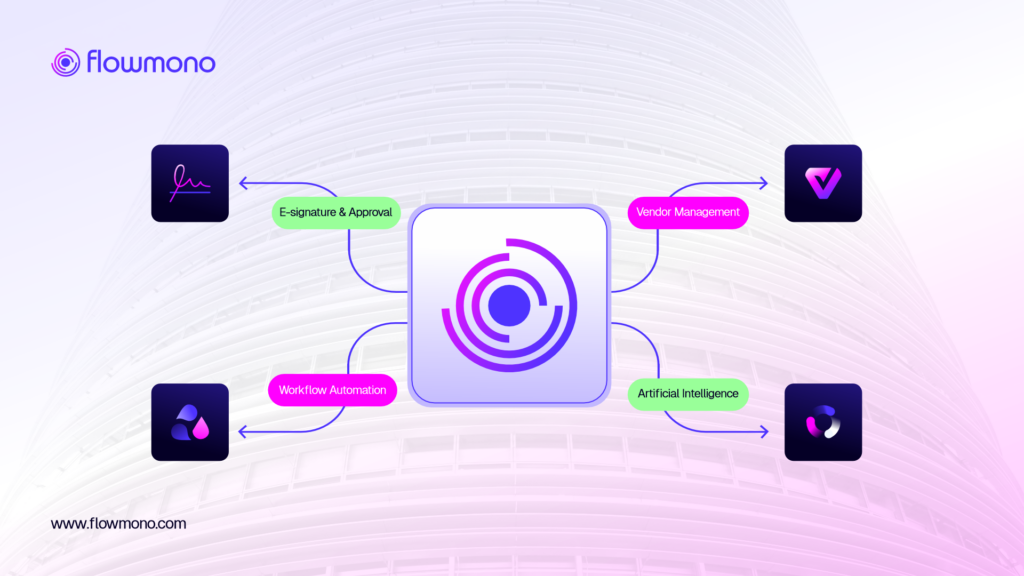
The companies pulling ahead in 2026 are not adding more tools. They are removing them.
For over a decade, enterprise software followed a simple rule:
Pick the best tool for every function and connect them.
It sounded logical. It worked for a while. But at scale, it broke.
Today, the average enterprise runs close to 900 applications. Fewer than a third of them are properly integrated. The rest create friction, delays, cost, and a system that cannot think.
The Problem Is Not the Tools. It Is the Gaps Between Them.
Every point solution works well in isolation. Procurement tools manage procurement.
E-sign platforms handle signatures. Project tools track delivery. But work does not happen in isolation. It happens in the handoffs. And that is where systems fail.
Data must be reconciled manually. Teams chase updates across platforms. Work is re-entered multiple times. Execution slows down. Errors increase. Costs rise quietly in the background.
Why the Model Is Breaking Down
1. Integration Debt Is Compounding
Every connection between two point solutions is a brittle dependency. When one system updates its API, the integration breaks. When a schema changes, the data reconciliation process fails. Gartner research shows that enterprise organisations spend an increasing share of IT budgets maintaining integrations rather than building new capabilities.
2. AI Cannot Work Across Silos
AI is only as powerful as the data it can access. An AI tool inside procurement sees procurement. It does not see vendor risk, project delays, or payment history. A unified system does. And that difference compounds.
3. Context Switching Is Destroying Output
Knowledge workers switch between applications over 1,200 times per day. The American Psychological Association estimates this consumes up to 40 percent of productive time. Point solutions maximise the number of systems workers must navigate. Product suites minimise it.
4. The Real Cost Is Hidden
Most enterprises compare tools based on subscription cost. That is the smallest cost component.
What they miss: integration maintenance, training across multiple interfaces, vendor coordination overhead, data reconciliation, and the cumulative productivity cost of switching. Forrester’s Total Economic Impact research shows organisations achieving 295 percent ROI over three years from consolidated workflow infrastructure, with a six-month payback period. That ROI is invisible in a subscription-only comparison.
What the Data Shows
| Finding | Source |
| 65% of enterprise SaaS buyers now prefer integrated solutions over fragmented tools | Gartner Enterprise Software Buying Patterns, 2025 |
| 295% ROI over 3 years from consolidated workflow infrastructure | Forrester Total Economic Impact Research |
| 23% increase in productive time within 6 months of workflow consolidation | Zapier Automation Index, 2024 |
| 40% reduction in context switching from automated task routing | McKinsey, cited in Zapier 2024 |
| 3.7x greater ROI from technology investments for organisations with strong integration infrastructure | IDC research across 4,000 business leaders |
What Product Suites Actually Change
This is not about convenience. It is about capability.
| Point Solution Stack | AI-Powered Product Suite |
| AI siloed inside individual platforms | One AI layer operating across all functions simultaneously |
| Data reconciled manually between systems | Single source of truth updated automatically across all workflows |
| Integrations break when any tool updates | Native connections requiring no external maintenance |
| Context switching between every function | Fewer system boundaries means fewer cognitive switches |
| TCO significantly underestimated | Full cost visible; ROI calculable against a single investment |
| Compliance trail assembled from multiple sources | Continuous AI-monitored audit trail built across all activity |
Case Study: Where the Time Actually Goes
A regional professional services firm running separate tools for e-signature, project management, procurement, and vendor management calculated that their procurement team was spending 38 percent of available hours on coordination overhead: chasing approvals, reconciling vendor data, updating four different systems with the same information.
After consolidating onto a connected platform, that overhead dropped to under 12 percent. The recovered capacity was redirected to strategic sourcing, vendor development, and client delivery.
That is not efficiency. That is leverage.
The Advantage Compounds
The real benefit of consolidation is not immediate. It compounds over time.
When systems share data, insights improve, decisions accelerate, and AI becomes more accurate. Fragmented companies cannot replicate this quickly — because the advantage is not in the software. It is in the data layer beneath it.
| AI + Flowmono: The Intelligence That Only Unified Data Produces On Flowmono, AI operating across vendor management, procurement, e-sign, and project execution generates insights no point solution can produce: which vendor categories are trending toward budget overrun, which approval patterns are creating systematic delays, which contract types generate the most compliance exceptions. This cross-functional intelligence is only possible when the data is unified. |
| The best-run enterprises in 2026 are not distinguished by the quality of their individual tools. They are distinguished by the quality of the connections between them, and by the AI intelligence that emerges when those connections are native rather than forced. |
Conclusion
The best-run enterprises in 2026 are not defined by the tools they use.
They are defined by how well those tools work together.
Point solutions optimise for functions.
Product suites optimise for execution. And execution is where advantage is built.
If your systems cannot think across your business, they are slowing it down.
Flowmono is a platform that brings e-sign, workflow automation, vendor and procurement management, and project execution into one connected system built to work together from the start.
