Understanding whether an e-signature legally binding across borders applies to your global contracts is the difference between a secure international deal and a void agreement.

Imagine closing a major cross-border partnership. Your company is based in Nigeria or Kenya, your buyer operates out of Delaware, and your primary vendor is registered in Germany. You finalize terms, email the agreement, and collect digital sign-offs using an e-signature tool. Two years later, a contract breach occurs, and your legal team prepares to enforce the agreement in an international arbitration tribunal.
The opposing legal counsel raises a single, devastating objection: “The electronic signature used on this contract fails to meet the statutory non-repudiation and identity verification standards required under local evidence laws.”
As global commerce accelerates, executing agreements across different legal jurisdictions requires navigating a complex patchwork of global statutory frameworks.
SUMMARY
– Global Statutory Validity: Electronic signatures are legally recognized in over 180 countries, but compliance levels vary by jurisdiction and document type.
– Key Frameworks: The US operates under the ESIGN Act and UETA (permissive model); the EU relies on eIDAS (tiered model); African nations enforce local statutes such as the Nigerian Evidence Act and South Africa’s ECTA.
– Cross-Border Enforcement: Enforceability depends on capturing a tamper-evident audit trail, SHA-256 cryptographic hashing, and multi-factor signer authentication.
UNDERSTANDING THE GLOBAL LEGAL FRAMEWORKS
Global e-signature laws generally fall into two legal philosophies: Permissive (US Model) and Tiered/Two-Tier (EU & African Model).
1. The United States: ESIGN Act & UETA (Permissive Framework)
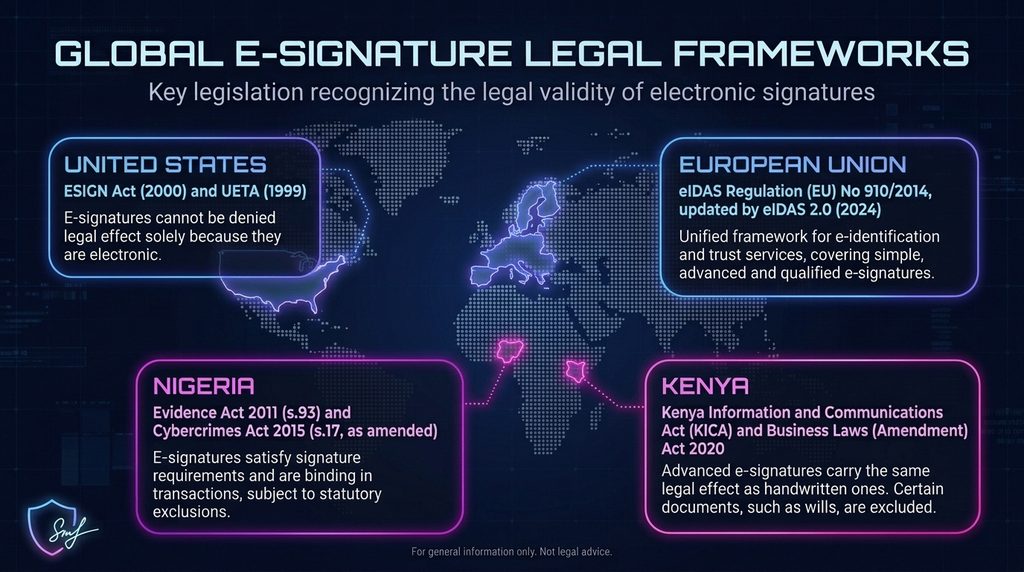
In the US, the Electronic Signatures in Global and National Commerce (ESIGN) Act and the Uniform Electronic Transactions Act (UETA) establish that a contract cannot be denied legal effect solely because it is in electronic format.
Key Requirement: Intent to sign, consent to do business electronically, and clear record retention.
Compliance Level: Standard Electronic Signatures (SES) are widely admissible for almost all commercial contracts.
2. The European Union: eIDAS Regulation (Tiered Framework)
The EU’s eIDAS Regulation (EU No 910/2014) classifies digital signatures into three distinct security tiers:
– Simple Electronic Signature (SES): Basic digital marks (suitable for low-risk internal memos).
– Advanced Electronic Signature (AES): Uniquely linked to the signer, capable of identifying them, and created under their sole control with tamper-evident document seals.
– Qualified Electronic Signature (QES): Backed by a Qualified Certificate and a Qualified Signature Creation Device (QSCD), carrying the exact legal equivalent of a handwritten signature in EU courts.
3. African Nations: Local Statutory Compliance
African jurisdictions combine permissive and tiered principles to govern electronic evidence:
– Nigeria: Sections 93(2) & (3) of the Nigerian Evidence Act (as amended) and the Cybercrimes Act of 2015 recognize electronic signatures as admissible primary evidence when identity and document integrity are cryptographically proven.
– South Africa: The Electronic Communications and Transactions Act (ECTA 25 of 2002) distinguishes between standard electronic signatures and Advanced Electronic Signatures (AES) for statutory requirements.
– Kenya: The Kenya Information and Communications Act (KICA) enforces strict certificate authority guidelines for digital signature admissibility.
COMPARATIVE ANALYSIS OF GLOBAL
E-SIGNATURE LAWS
| Jurisdiction | Primary Governing Statute | Security Tier Required for B2B Contracts | Key Admissibility Barrier |
| United States | ESIGN Act & UETA | Simple / Basic Electronic Signature | Lack of proven signer intent or record access |
| European Union | eIDAS Regulation | Advanced Electronic Signature (AES) | Lack of post-signature tamper-evidence |
| Nigeria | Nigerian Evidence Act (Sec 93) | Authenticated Digital Signature | Inability to prove document integrity post-execution |
| South Africa | ECTA (Act 25 of 2002) | Advanced Electronic Signature (for statutory forms) | Absence of accredited digital certificates |
To learn how cryptographic auditing satisfies international legal requirements, read our complete guide on Why Your E-Signature Audit Trail Matters More Than You Think.
7 RULES TO GUARANTEE CROSS-BORDER
CONTRACT ADMISSIBILITY
To ensure your international contracts hold up in court across Africa, the US, and the EU, enforce these seven technical controls:
1. Prove Explicit Intent and Consent
Every signer must actively check a box or click an explicit button confirming their consent to conduct business electronically before accessing the agreement.
2. Authenticate Signer Identity
Deploy multi-factor authentication (such as SMS One-Time Passwords or verified email links) to prove exactly who accessed and executed the agreement.
3. Apply SHA-256 Cryptographic Hashing
To satisfy eIDAS and local Evidence Acts, every completed document must be sealed with a SHA-256 cryptographic hash. If a single character is altered post-signature, the mathematical hash changes, alerting the court to document tampering.
4. Embed RFC 3161 Trusted Timestamps
Device system clocks can be altered. Use an RFC 3161 certified Timestamp Authority to record the exact time of viewing, signing, and delivery.
5. Generate Automated Audit Certificates
Maintain an immutable audit trail capturing IP addresses, device metadata, email logs, and timestamped actions.
6. Verify Local Statutory Exceptions
Certain documents, such as real estate transfers, wills, court orders, and power of attorney filings—are explicitly excluded from standard e-signature laws in many jurisdictions and require wet signatures or specialized notarization.
7. Store Records in a Centralized Digital Archive
Ensure all parties receive a downloadable, unalterable PDF copy of the executed contract along with its audit certificate. To explore how digital execution works behind the scenes, read How Electronic Signatures Work.
Cross-Border Contract Execution with Flowmono
Executing cross-border agreements should not require a legal team for every transaction. By combining multi-factor signer authentication, SHA-256 cryptographic sealing, and automated audit certificates, Flowmono guarantees that your global agreements remain fully admissible across local and international jurisdictions. Discover more details about how this works here.
