
If your team is spending money on AI initiatives that feel busy but rarely change how work actually gets done, you are facing a common problem.
Most companies approach AI by picking a tool, handing it to a team, and expecting instant results. But if you look at the actual track record across the industry, that approach falls flat. Almost nine out of ten organizations have deployed AI in at least one department, yet only 12% have managed to raise revenue while cutting costs. In fact, more than half of executives say their AI investments haven’t made a noticeable impact on their bottom line.
Engineering teams build impressive prototypes, but between 70% and 95% of these projects gets delayed before they ever handle real, daily work. When you look closely at recent industry trends, the number of abandoned AI initiatives has more than doubled over the past year.
To stop wasting time and money, you have to stop asking “Can AI do this task?” and start asking “Is our underlying process actually clean enough for AI to handle?”
Understanding the Maturity Frameworks
When companies realize their AI projects aren’t delivering, they usually look for a framework to measure their readiness. Right now, there are about 17 major frameworks floating around. The mistake most leaders make is choosing one based on brand recognition rather than how their business actually operates.
These frameworks fall into five general groups:
1. Enterprise Consulting Models: Tools from firms like Gartner, McKinsey, or PwC work best for massive corporations with huge transformation budgets. They require weeks of executive interviews and significant consulting overhead.
2. Engineering-Grade Platforms: Options like AWS’s CAF-AI, IBM GenAI, or Microsoft’s 7 Pillars focus heavily on deployment mechanics. They work well for technical teams, but they often act as a subtle pipeline to lock you into that specific provider’s cloud ecosystem.
3. Mid-Market and Public Sector: Practical options like Singapore’s AIRI give smaller teams straightforward guidance without requiring dedicated strategy departments, though they are often tied to specific regional regulations.
4. Academic Frameworks: Models from places like MITRE or MIT Sloan offer neutral, evidence-based self-diagnostics. They are great for deep analysis, but they leave you without a step-by-step rollout plan.
5. Audit and Compliance Standards: Frameworks like CMMI AIM target highly regulated sectors like finance and healthcare. They require rigorous evidence, certified appraisers, and formal audits.
If you operate in a heavily regulated industry, a high-level strategy score won’t protect you during a compliance review. For example, a mid-market fintech team that initially used a light, academic framework to check their readiness. While it gave them a good baseline, it lacked the paper trail required when they applied for a new banking license. They had to switch to the CMMI Artificial Intelligence Maturity Framework so they could link their operational processes directly to international standards like ISO 42001 and ISO 31000, turning a basic evaluation into an auditable compliance asset.
The Danger of the Average Score
The most costly mistake you can make when evaluating AI readiness is relying on a composite or average score. Imagine your team grades its readiness across three areas:
1. Strategy: 8 out of 10
2. Team Skills: 9 out of 10
3. Data Control: 0 out of 10
Your overall average comes out to a comfortable 5.7 out of 10. In a standard business report, a 5.7 looks like a solid starting point. But in an operational process, a zero in data control means complete system failure.
AI does not care about your average. It runs on the Anchor Principle: your process is only as mature as its single weakest step. If your data foundation is messy or inconsistent, an advanced AI model will only automate that mess at a faster rate.
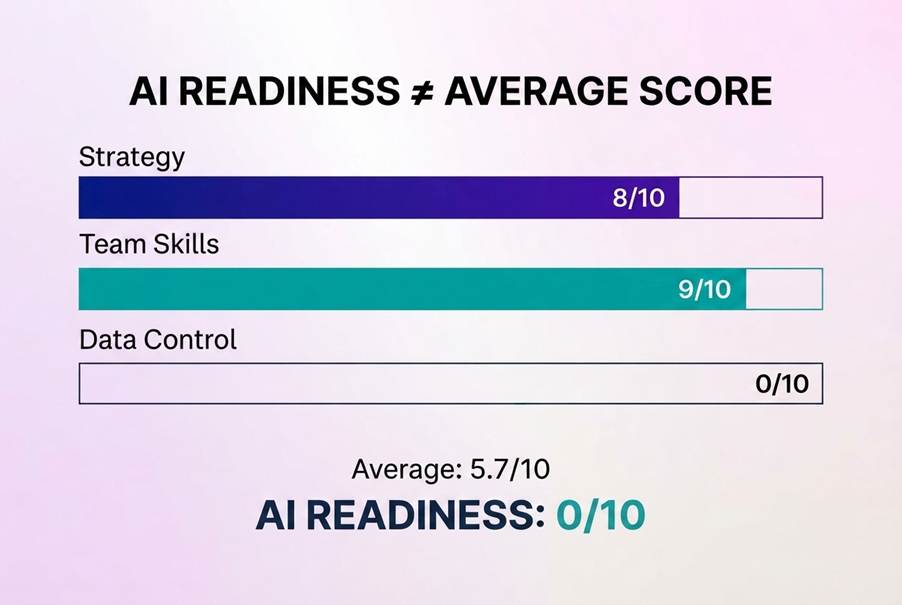
High average scores give leadership false confidence. A CEO looks at an overall 8 in strategy and pushes to scale the project, while the operational team is struggling with broken inputs. Pushing AI into an unstable process leads to bad outputs, security risks, and broken customer trust.
How AI Changes Process Requirements
Traditional software is predictable. If you enter specific data, you get the exact same result every time. Updating a standard database requires simple rule checks and predictable logic.
AI is different. It interprets context rather than following rigid rules. Because its outputs can vary, evaluating whether a process is ready requires a different set of standards:
1. Data Management: Standard software needs organized database fields. AI needs clear data history, real-time context, and fast access to relevant information.
2. System Errors: Standard software stops working and gives you an error code when something goes wrong. AI fails smoothly—it gives you a confident, well-written answer that is entirely incorrect without raising any alarms.
3. Security: Instead of just setting up login permissions and firewalls, you have to protect your workflow against manipulative prompts, bad inputs, and data leaks.
4. Accountability: Basic uptime metrics aren’t enough. You need human review points and clear records showing how decisions were made.
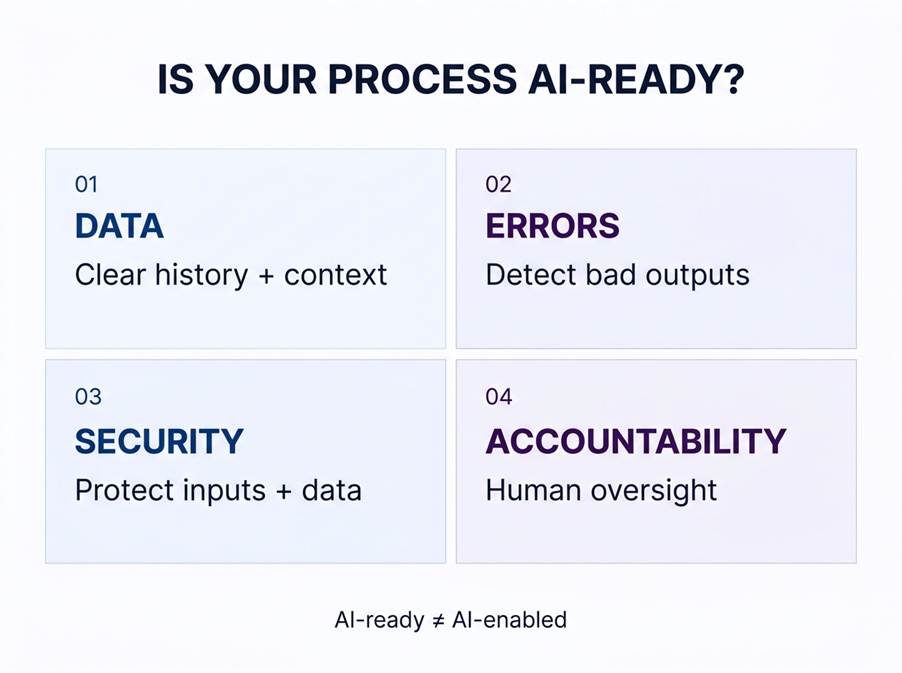
A practical operational team prioritizes human oversight. Because AI can sound convincing even when it gets things wrong, your true process maturity depends on how quickly your team can catch and correct errors before they reach a customer or an auditor.
Preparing Workflows for Autonomous Execution
The focus in business automation is shifting from simple internal chatbots to autonomous workflows where systems carry out multi-step tasks on their own. However, industry analysts expect up to 40% of these agent-based projects to be dropped over the next few years because companies don’t have the right risk controls or clear performance tracking in place.
This is where the orchestration layer becomes non-negotiable. Before an AI agent can execute tasks reliably, your core workflow must be standardized and clean. Platforms like Flowmono automate solve this operational bottleneck by structuring your underlying tasks, removing approval delays, and enforcing clear authorization rules before any AI technology is introduced.
If you want a process to handle autonomous execution smoothly, three basic conditions must be met:
1. Standard Connections: Your systems need clear, consistent ways to talk to one another. Using established setup standards like the Model Context Protocol lets software agents pull data and complete tasks across your existing tools without needing fragile, custom code.
2. Fresh Information: Running overnight batch updates slows everything down. If an automated system makes decisions using yesterday’s data, it creates errors instead of saving time.
3. Automated Safety Checks: You cannot rely on manual reviews after a process is already running live. System monitoring, drift detection, and basic safety rules need to be built directly into the workflow itself.
A Four-Phase Rollout Plan
To take an AI project from an idea to a reliable business process, move it through four distinct phases:
1. Validate (Weeks 1–4): Measure your current baseline before introducing any new tools. How long does the task take right now? What does it cost per item? How often do manual mistakes happen?
2. Harden (Weeks 5–10): Set up your safety controls. Build clear audit logs, track usage costs, and establish access controls before opening the tool up to a wider team.
3. Expand (Weeks 11–16): Roll the process out to a broader department. Most projects hit snags here because hidden data issues show up, use this period to fix those operational gaps.
4. Optimize (Ongoing): Shift your attention from proving that the tech works to tweaking performance, cutting down handling time, and lowering costs.
A helpful operational rule of thumb to keep in mind is that 10% of your effort goes into picking the model, 20% goes into the underlying tech stack, and 70% goes into redesigning the actual process and training your team.
Fixing the Workflow First
A readiness score isn’t a final grade, and a good strategic plan won’t make up for an unstable workflow. You are always bound by your weakest operational link.
Real value isn’t buried inside an AI algorithm; it comes from how well you structure your underlying day-to-day operations. If you add AI to a messy, chaotic process, you just get a faster, more expensive chaotic process.
Before trying to automate complex decision-making, you need a system that brings complete order to your operational execution. By standardizing your approvals, routing documents smoothly, and building clear audit paths across your existing tools, Flowmono automate creates the stable, transparent foundation your team needs to run automated workflows reliably and see real, measurable returns.
