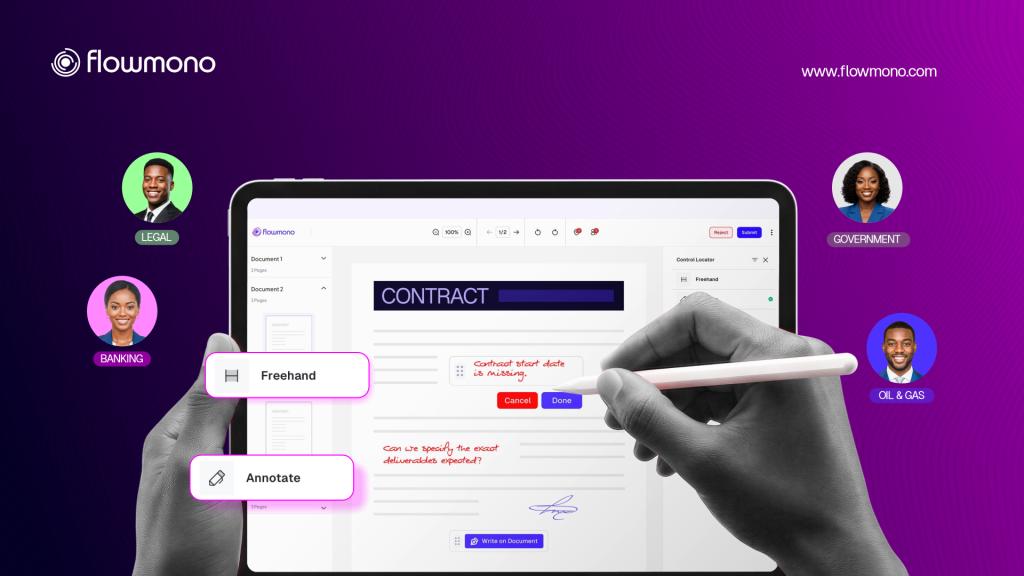
The Freehand Tool is not an abstraction. These are the specific documents, the specific workflows, and the specific signing conventions it is changing.
The Common Thread
Across every industry where the Flowmono Freehand Tool is deployed, the same pattern appears: there is a class of documents that senior decision-makers interact with in ways that are inherently contextual. The executive is not completing a form. They are reviewing a document, making judgements, and leaving marks that reflect those judgements at the specific points in the text where those judgements were formed.
Conventional e-signing infrastructure cannot accommodate this interaction without either breaking the workflow or requiring the executive to operate in a different mode than their natural review behaviour. The Freehand Tool and the Free Signer designation are built to handle these specific, industry-level interaction patterns.
Banking
The primary document challenge in banking at the executive level is the credit approval process. A credit committee member reviewing a term sheet or credit facility agreement does not simply sign at the bottom. They mark the exposure limit, initial next to the risk grading, and add conditions adjacent to the covenant clauses. If the review results in a conditional approval, those conditions need to be recorded on the document itself, not in a separate email.
With the Flowmono Freehand Tool, the credit committee member opens the document on iPad, reads through it, and marks directly at the relevant clauses. Their signature and any conditional annotations are captured by the audit engine with timestamps and identity links. The complete credit decision record, including the conditions and their exact location in the document, is part of the signed file.
For correspondent banking agreements, KYC declarations, and AML compliance documents, where regulatory requirements make the completeness of the signing record critical, the six-layer architecture ensures that the audit trail is unbroken from document receipt through annotation through submission.
| In banking, a conditional approval that exists only in an email has a different legal character than a conditional approval written directly onto the authorised document. The Freehand Tool makes the latter the default. |
Legal Operations
In-house legal teams process a continuous stream of NDAs, engagement letters, matter authorisation documents, and regulatory submissions. Many of these documents require sign-off from a General Counsel or senior legal officer who has specific concerns about particular clauses and wants to record those concerns on the document.
The conventional e-signing experience for this use case is inadequate. A single signature field at the end of the document does not capture the nuance of a legal review. The GC who signs an external counsel instruction letter and adds a handwritten note limiting the scope of the instruction to specific proceedings is making a legally meaningful amendment to the document. That amendment needs to be on the document, not in a follow-up email.
The Freehand Signer allows legal executives to sign the way they review: with marks, notes, and initials at specific clauses, and a signature that sits adjacent to the authorising language rather than in a generic field at the footer. The Free Signer designation is particularly useful for external counsel who need to confirm instructions, accept scope limits, or note fee arrangements directly on the engagement letter.
Oil and Gas
The oil and gas operating environment creates document signing challenges that are unique in their physical and technical character. Engineering markups involve annotating technical drawings, piping diagrams, and inspection records in ways that are location-specific: the annotation needs to be at the precise point on the drawing it refers to, not in a field at the top of the page.
Site inspection documents require engineers to annotate findings as they move through the inspection, with marks at the relevant equipment, line, or structure in the drawing. The Freehand Tool on iPad with Apple Pencil is purpose-built for this interaction: the engineer holds the iPad, moves through the inspection, and marks the drawing in real time at the relevant locations.
Contractor compliance records and completion certificates in oil and gas carry significant financial implications. The signature on a milestone completion certificate releases payment. The Freehand Signer ensures that these documents carry the same audit quality as any formally executed contract, with every annotation timestamped and identity-linked in the tamper-evident audit trail.
Government
Government document workflows involve a combination of formal requirements and practical realities that create specific challenges for conventional e-signing tools. Memo approvals, regulatory filing cover pages, and procurement submissions require the signatures of named officials, but the format and position of those signatures often varies based on the specific procedure and the official’s preference.
Senior government officials are among the professional cohort most likely to prefer the pen-on-paper interaction precisely because of the intentional, deliberate quality of the act. The Freehand Signer, on iPad with Apple Pencil at sub-16ms latency, provides that quality digitally. The official signs the way they prefer to sign. The platform records the event with the full governance and audit infrastructure that regulatory requirements demand.
The Free Signer designation is particularly valuable for government use cases where external parties such as procurement suppliers, regulatory submitters, or licensed contractors are required to sign documents in contexts where their exact interaction cannot be predetermined.
Construction
Construction is one of the highest-volume document environments in any industry. Subcontractor agreements, variation orders, completion certificates, milestone payment authorisations, health and safety compliance documents, and client handover records all require signatures, often from multiple parties, often in the field rather than in an office.
Variation orders are particularly representative of the Freehand Tool’s value in construction. A variation order documents a change to the agreed scope of work and must be signed by both the contractor and the client representative before the work proceeds. The variation may be negotiated on site, with both parties present. The Freehand Signer allows both parties to sign the variation order on the spot, on the same iPad, with their marks timestamped and identity-linked at the moment they are placed.
Health and safety compliance documents in construction require annotation at specific risk items identified during the inspection. The document’s signing interaction is inseparable from its content: the inspector signs next to each finding they are certifying. Freehand Mode makes this natural.
Insurance
In insurance, the document workflow extends from policy issuance through claims handling to settlement. Executive-level documents in insurance include reinsurance treaty agreements, settlement discharge forms, and high-value claims authorisations, all of which involve senior signatories whose review includes assessment of specific terms, conditions, and exclusions.
The claims adjuster authorising a high-value settlement may want to initial next to each agreed figure in the settlement schedule and add a note confirming that a specific exclusion was considered and determined not to apply. The settlement discharge form carries more evidentiary value when it contains these specifics than when it contains only a signature at the footer. The Freehand Signer makes this level of documented specificity accessible to every senior claims executive on every settlement document.
Across all of these industries, the Flowmono Freehand Tool changes one thing: it makes the document signing interaction match the way senior decision-makers actually work with documents. Explore the Flowmono Freehand Tool across your industry.
