The field told the executive where to sign. The Freehand Signer lets the executive decide.
How the Executive Actually Reviews Documents
A CFO reviewing a term sheet does not read it sequentially from top to bottom and sign at the end. They scan the document for the clauses that require attention, mark those clauses, add a note, initial next to the passage they are specifically accepting, and sign at a location that feels appropriate to them, often next to the section they consider most consequential.
A General Counsel reviewing an external counsel instruction letter reads for scope limitations, marks the passages they are accepting on their own authority versus those requiring board sign-off, and signs near the instruction paragraphs, not at a pre-formatted signature field at the footer.
A CEO approving a capital expenditure authorisation wants to mark the figure they are approving, add a condition note if one applies, and sign adjacent to the authorised line item. Not in box B7 where the template developer placed a field three weeks ago.
Conventional e-signing tools are designed for the document, not the executive. They work well when the signing position can be standardised. They create friction and workflow reversal when it cannot. Placeholderless signing redesigns the interaction around the executive’s actual review behaviour.
The Cost of Sending a Document Back
When a document arrives at a senior signatory and the signature field is in the wrong position, or there is no annotation capability, or the executive simply will not interact with a form-based signing tool, one of three things happens. The executive prints it. The document gets returned for field repositioning. Or the executive flags it to a PA who manages the signing on their behalf.
Each outcome has a cost. Printing reintroduces the print-sign-scan cycle and its associated time and audit trail gaps. Returning the document for repositioning adds a delay cycle to every document that arrives with an unconventional signing convention. Delegating to a PA introduces an intermediary into a signing event that may have legal or regulatory attribution requirements attached to the named signatory.
| The friction of the wrong field placement does not just delay the document. It shapes the executive’s opinion of every digital signing tool they encounter, making future adoption harder regardless of the tool’s quality. |
What Placeholderless Means in Practice
Placeholderless signing means the document arrives with no pre-configured signature positions. The annotation tool is active. The executive opens the document, navigates to whatever page or passage they choose, and places their mark.
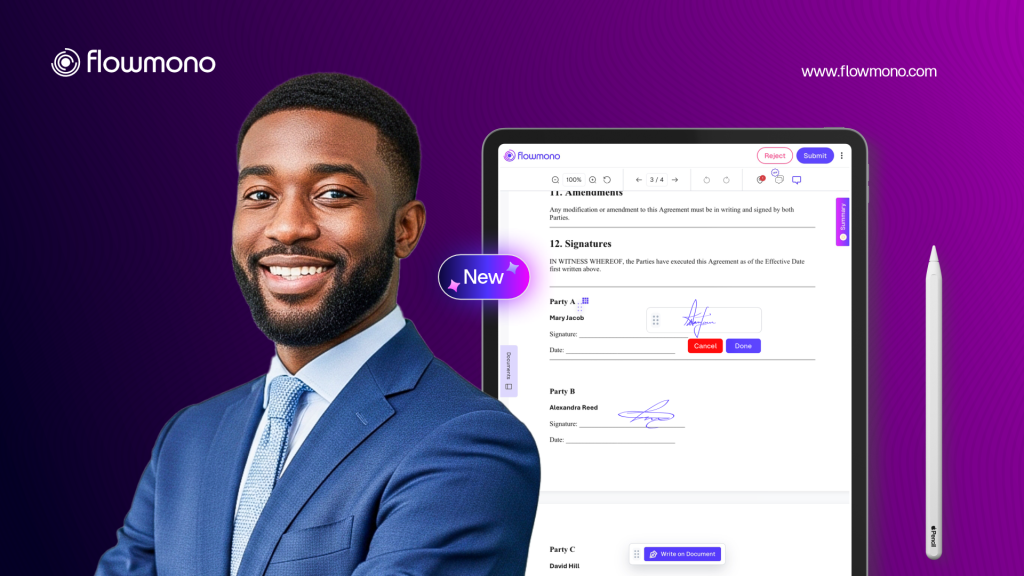
In the Flowmono Freehand Signer, this experience runs on iPad with Apple Pencil at sub-16ms latency. The interaction is: pick up the Pencil, sign on the screen where you choose. That is the entire signing experience. There are no fields to locate, no boxes to click inside, no form elements to interact with.
For executives who have historically preferred handwritten signatures precisely because of the physicality and intentionality of the act, this resolves the core objection. The Pencil on the iPad at that latency is the physical act. The governance infrastructure behind it means the result is more defensible than a wet ink signature on paper.
The Free Signer Experience for External Executives
For external parties such as counterparty executives, independent directors, external auditors, or senior government officials, the Free Signer designation removes an additional layer of friction. These signatories are unlikely to be users of the Flowmono platform in the ordinary course of their work. Requiring them to navigate a signing interface, locate a field, and complete a structured signing process is a friction point that some will resolve by printing the document.
When an Organisation Admin has designated an external executive’s email address as a Free Signer address, their experience is simplified to its minimum. They receive the document. They open it. The annotation tool is already active. They sign where they choose. They submit. The process is familiar because it mirrors what they would do with a pen.
1. Document arrives in the Free Signer’s inbox
The initiator has sent the document through Flowmono. No signature fields have been placed for this recipient because none are required. An optional highlight may indicate the preferred signing area, but the signer is not bound by it.
2. Free Signer opens the document
The annotation tool activates automatically. The Free Signer does not need to click to enable it or navigate any interface. They are in signing mode from the moment the document opens.
3. Free Signer places their marks
Using Apple Pencil on iPad, the Free Signer writes their signature, adds initials, annotates passages, or leaves handwritten notes directly on the document. Every stroke is rendered at under 16ms latency. The experience is identical to pen on paper.
4. Free Signer submits
The document is submitted. The workflow engine routes it to the next step. The audit engine has captured every stroke with a timestamp and identity link. The document is complete, governed, and ready for its next destination.
| The AI intelligence layer in the Flowmono Freehand Tool classifies each annotation made by the Free Signer: signature, initials, text, or freehand markup. This classification enriches the audit record and makes the document’s signing history searchable and readable without requiring a human to interpret the handwritten marks. |
The Governance That Makes Flexibility Possible
Placeholderless signing is only viable as an enterprise document standard if the governance framework is robust enough to compensate for the absence of structured fields. The Flowmono architecture provides that framework through the audit engine and AI intelligence layer.
Every annotation placed by a Free Signer is timestamped at the moment of the stroke, identity-linked to the authenticated user account, spatially recorded with exact page coordinates, and classified by the AI layer. The resulting audit record is equivalent in legal and evidentiary quality to a structured signing event. The flexibility in the signing experience does not reduce the quality of the evidence the event produces.
Executives who sign the way they prefer to sign, and organisations that require full audit records of every signing event, no longer have to choose between these requirements. See the Flowmono Freehand Signer.
