If Your E-Signature Doesn’t Have a Cryptographic Audit Trail, It Isn’t Defensible in Court

A digital signature without a tamper-evident audit trail is just an image pasted on a PDF. If a contract is challenged in litigation or an enterprise compliance audit, presenting a scanned image or a typed name proves nothing. What holds up in court under global statutes like the US ESIGN Act, the EU eIDAS regulation, and local frameworks such as Sections 93(2) & (3) of the Nigerian Evidence Act and the Cybercrimes Act of 2015 is an immutable, cryptographically secured audit trail that proves who signed, when they signed, and that not a single byte of the document was altered post-execution.
Key Takeaways
– Audit Log vs. Audit Trail:
A log is raw event data; a legal audit trail is an end-to-end, tamper-evident reconstruction of a document’s lifecycle.
– Tamper-Evidence:
Achieved through SHA-256 cryptographic hashing, PKI digital certificates, RFC 3161 timestamps, and immutable metadata.
– Legal Admissibility:
Courts admit electronic contracts as primary evidence only when the platform provides non-repudiation and proof of zero document modification.
What Makes an Audit Trail Truly “Tamper-Evident”?
To qualify as tamper-evident under global security standards (such as NIST guidelines), an e-signature platform must deploy cryptographic controls that flag any post-signing modification immediately.
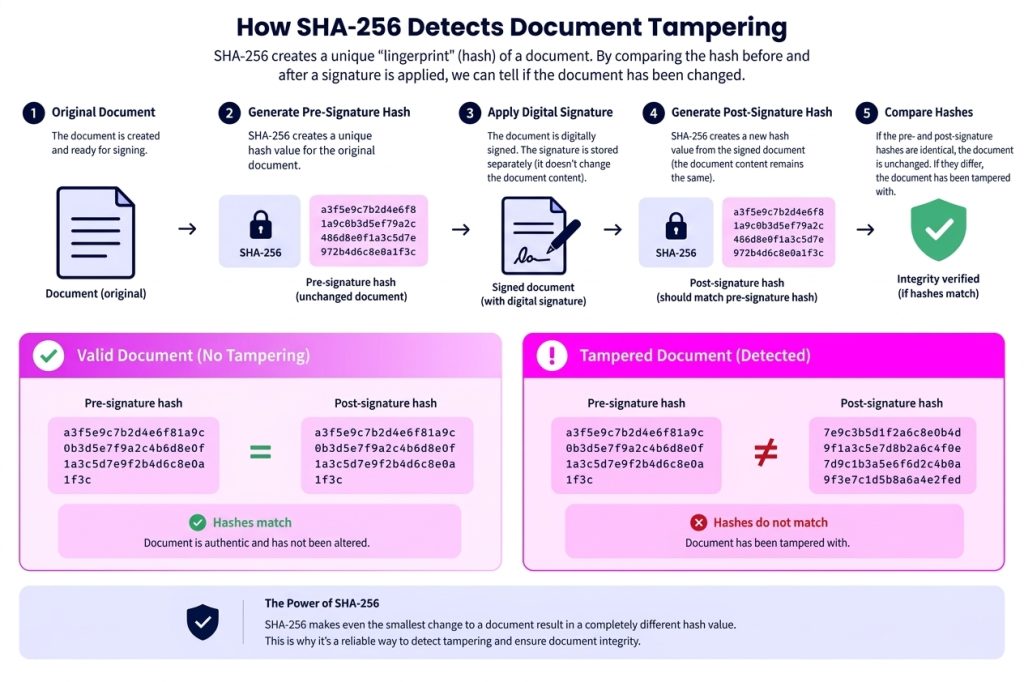
Here are the 4 core technical components that guarantee an audit trail is legally defensible:
1. Cryptographic Hashing (SHA-256)
When a document is uploaded to an e-signature engine, the system calculates a unique mathematical fingerprint known as a SHA-256 hash.
– If a single period, space, or digit is modified in the PDF after signing, the document’s cryptographic hash changes completely.
– Standard readers like Adobe Acrobat automatically read this hash and display a warning banner stating: “The document has been altered since this signature was applied.”
2. Public Key Infrastructure (PKI) & Digital Certificates
Tamper-evident audit trails embed a digital certificate directly into the PDF payload using PAdES (PDF Advanced Electronic Signatures) standards. This certificate binds the signer’s verified identity to the document using asymmetric encryption.
3. RFC 3161 Trusted Timestamps
Device system clocks can easily be manipulated. Legal-grade audit trails pull time from a certified Timestamp Authority (TSA) compliant with the RFC 3161 protocol, providing indisputable proof of the exact minute and second a document was viewed and signed.
4. Complete Metadata Capture
According to National Institute of Standards and Technology (NIST) frameworks, a valid legal audit trail must capture these core variables:
| Metadata Field | What It Records | Why Courts Require It |
| Actor Identity | Verified email, phone, or OTP verification | Establishes identity and explicit intent to sign. |
| IP Address & Context | Public IP address, device type, operating system | Proves the originating physical and digital location. |
| Action Log | Creation, viewing, approval, signing, downloading | Establishes an uncompromised chain of custody. |
| Document Hash | Cryptographic SHA-256 checksum | Guarantees zero document tampering post-signature. |
Why Documents Signed with Flowmono Are Admissible in Court
In a legal dispute, the burden of proof rests on demonstrating that the signature is authentic and the record has remained unaltered. Documents executed via Flowmono E-Sign are explicitly admissible in court because the platform aligns directly with statutory requirements across both global and emerging markets:
– Statutory Compliance: Flowmono satisfies the requirements of Sections 93(2) & (3) of the Nigerian Evidence Act and the Cybercrimes Act of 2015, while maintaining structural alignment with the US ESIGN Act and EU eIDAS (Advanced Electronic Signatures / AES) standards.
– Non-Repudiation Architecture: By binding signer authentication (email, OTPs, and IP tracking) directly to a time-stamped digital certificate, signers cannot legitimately deny their intent or execution.
– Automated Audit Certificates: Every completed transaction on Flowmono automatically generates a downloadable, tamper-evident audit certificate embedded directly with cryptographic hashes, proving document integrity from creation to final archive.
For an in-depth breakdown of legal frameworks governing digital execution, read our complete guide on E-Signatures vs. Digital Signatures: A Guide to Securing Your Agreements or read more on how top organizations secure their contracts in Why Your E-Signature Audit Trail Matters More Than You Think.
