Enterprise AI is moving from tools that respond when asked to systems that act with purpose. Document signing is where that shift becomes commercially significant, and where most platforms are already falling behind.
Every meaningful shift in enterprise technology follows the same arc.
First, a manual process gets digitized. Then the digital process gets automated. Then the automation gets intelligence. The gap between those three stages is not cosmetic. Each one represents a fundamentally different relationship between the system and the work it governs.
Document signing has been through the first two stages for most organizations. Paper became digital. Digital became electronic. What is happening now is the third stage: electronic signing is acquiring intelligence. Not intelligence that responds when instructed. Intelligence that understands context, recognizes patterns, and acts within defined parameters without waiting to be told.
That capability has a name. It is called agentic signing. And understanding it is not a matter of keeping up with technology trends. It is a matter of understanding where your document workflows are going and whether your current platform can get you there.
The World Agentic AI Is Building
Gartner’s 2025 Emerging Tech Report states that more than 60 percent of enterprise AI rollouts in 2025 embed agentic architectures, meaning AI that does not just generate output but plans, decides, and acts across multiple steps. This is not a specialist deployment. It is the direction enterprise AI is moving broadly and rapidly.
The numbers behind that direction are significant. A 2025 Deloitte study predicts that by 2026, more than 60 percent of large enterprises will have deployed agentic AI at scale. MuleSoft and Deloitte Digital’s 2025 Connectivity Benchmark report found that 93 percent of IT leaders report intentions to introduce autonomous agents within the next two years, and nearly half have already implemented some form.
McKinsey’s 2025 State of AI survey found that 88 percent of organizations regularly use AI in at least one business function, up from 78 percent the year before. But only about one third have started scaling AI across the enterprise. 2026 is when many businesses move from pilot projects to operational AI deployment.
The question for document-intensive organizations is not whether agentic AI is coming to their workflows. It is whether their current document platform will be part of that deployment or a bottleneck standing in front of it.
Three Levels of Automation:
Where Most Platforms Are Still Stuck
To understand what makes agentic signing different, it helps to position it against the two stages that preceded it.
| Capability | Stage 1: Rule-based automation | Stage 2: AI-assisted automation | Stage 3: Agentic automation |
| How it triggers | Defined rules fire when conditions are met | AI generates suggestions, flags issues, waits for human confirmation | AI acts within defined boundaries, completes tasks, escalates only genuine exceptions |
| Document recognition | Recognizes document type from explicit metadata | Identifies probable category from content | Understands document context, maps to signing profile, applies correct signature |
| Human involvement | Human initiates every action | Human reviews AI suggestions before acting | Human reviews and submits. AI handles the preparatory work within established parameters |
| What it replaces | Paper and manual filing | Manual data entry and flagging | Manual selection, manual routing, and manual format verification at every signing event |
| Where most platforms sit today | Legacy platforms | Most modern e-sign platforms | Flowmono AI Co-Signer |
The critical difference between Stage 2 and Stage 3 is not the quality of the AI. It is the nature of the action. A Stage 2 system surfaces information and waits. A Stage 3 system acts within defined boundaries and surfaces only the exceptions that require human judgment. The volume of routine work that requires human attention drops significantly. The quality of attention given to the work that remains rises proportionally.
What Agentic Signing Specifically Means for Document Workflows
Agentic signing is the application of agentic AI principles to the document signing context. It means the signing system understands what a document is, knows what signing behavior is appropriate for that document type, acts on that knowledge when the document arrives, and reserves the human’s involvement for review and final submission rather than for mechanical selection and verification.
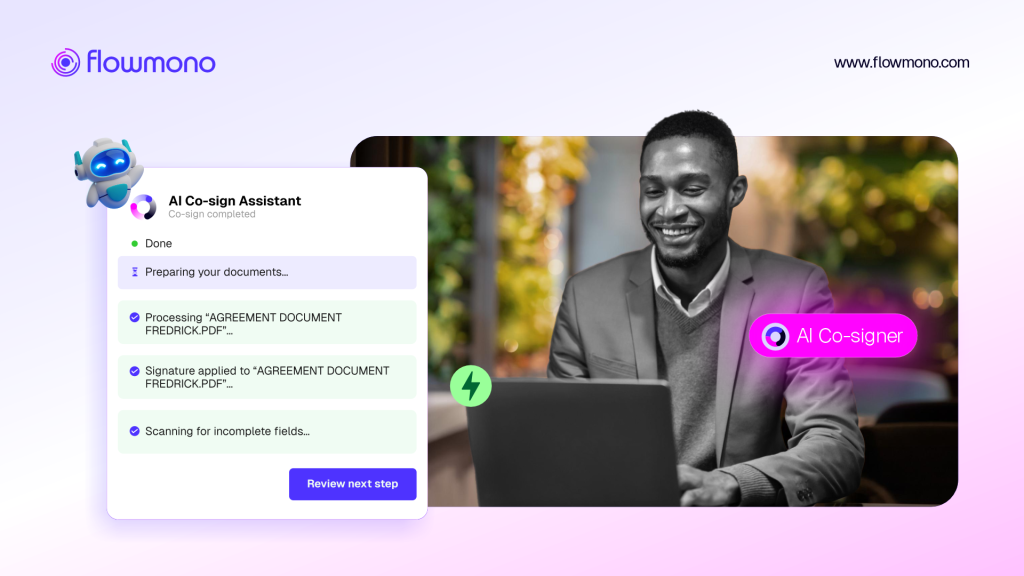
On Flowmono, this capability is live today as AI Co-Signer. When a document arrives in a user’s signing queue, the platform does not wait for the user to identify the document type, navigate to the signature field, and select the appropriate format manually. It has already done that. The document opens with the correct signature in place. The user reads it, confirms it is accurate, and submits.
That sequence sounds simple. Its significance is not. Every signing event that occurs without the user performing the selection step is an event where professional attention was directed entirely at the substance of what was being signed rather than the mechanics of how it was being signed. Multiply that across hundreds of monthly signing events in a legal operations team, a finance function, or a procurement department, and the reclaimed capacity is material.
How Agentic Signing Works on Flowmono
AI Co-Signer on Flowmono operates through a two-step configuration that transfers the organizational knowledge your team already holds into the platform.
1. Create your signature or upload an existing one
Within Flowmono, you define the signature formats your organization uses. Your formal signature for external-facing agreements. Your initials for internal routing. A specific sign-off format for regulated documents requiring a particular authorization standard. Each format is created once and stored. You can have as many signatures as your role and organizational conventions require.
2. Map document categories to each signature
For each signature you create or upload, you assign one or more document categories. The platform then uses those mappings as the decision logic it applies when a document arrives. You can assign multiple categories to a single signature when the same format applies across more than one document type. Once saved, the configuration runs automatically from that point forward.
| What happens next: Once the mapping is saved, AI Co-Signer references it every time a document is opened. If the document matches a known category, the correct signature is already in place when the user opens it. If the document does not match a known category, the user’s default signature is applied automatically, and the user retains full authority to review and decide whether to submit. Nothing is ever submitted without the user’s explicit confirmation. |
Why Agentic Signing Matters More Than Faster Signing
The benefit that most people describe when they encounter AI Co-Signing is speed. Documents get signed faster. Queues clear more quickly. Turnaround improves. Those outcomes are real.
But they are not the most significant outcome.
Stanford HAI and MIT CSAIL research on agentic AI systems across business settings found time savings of 65 to 86 percent versus human-only workflows for tasks where AI handled the preparatory work and humans handled the decision. One enterprise logistics case reduced planning time from five hours to thirty-five minutes. The savings are not from doing the work faster. They come from removing the human from the parts of the work that do not require human judgment.
For document signing, the implication is precise. The judgment in a signing event is the decision to sign: reviewing the document, understanding the commitment it represents, and confirming you are prepared to take on that commitment. The mechanics of selecting the right format for the document type are not judgment. They are overhead. Agentic signing removes the overhead so the judgment can be applied with full attention.
The organizations that will define document workflow excellence in the next three years are not the ones that sign documents fastest. They are the ones whose teams bring full attention to every document that requires it, because the mechanical work that was previously consuming that attention is now handled by the platform. That shift does not happen gradually. Flowmono’s AI Co-Signer makes it available today.
| 60%+ | of large enterprises will have deployed agentic AI at scale by 2026. The document workflow is one of the highest-impact deployment contexts because it sits at the centre of every approval, commitment, and compliance event in the business. Source: Deloitte, 2025 (via market.us) |
| Agentic signing is not the future of document workflows. It is the present. The question is not whether your organization will operate this way. It is whether the platform you are on today can deliver it. |
See Agentic Signing Live on Flowmono
AI Co-Signer is live on Flowmono now. Configure your signature profiles in two steps. Map your document categories. Watch the mechanical overhead disappear from every signing event that follows.
New to Flowmono? Start here.
